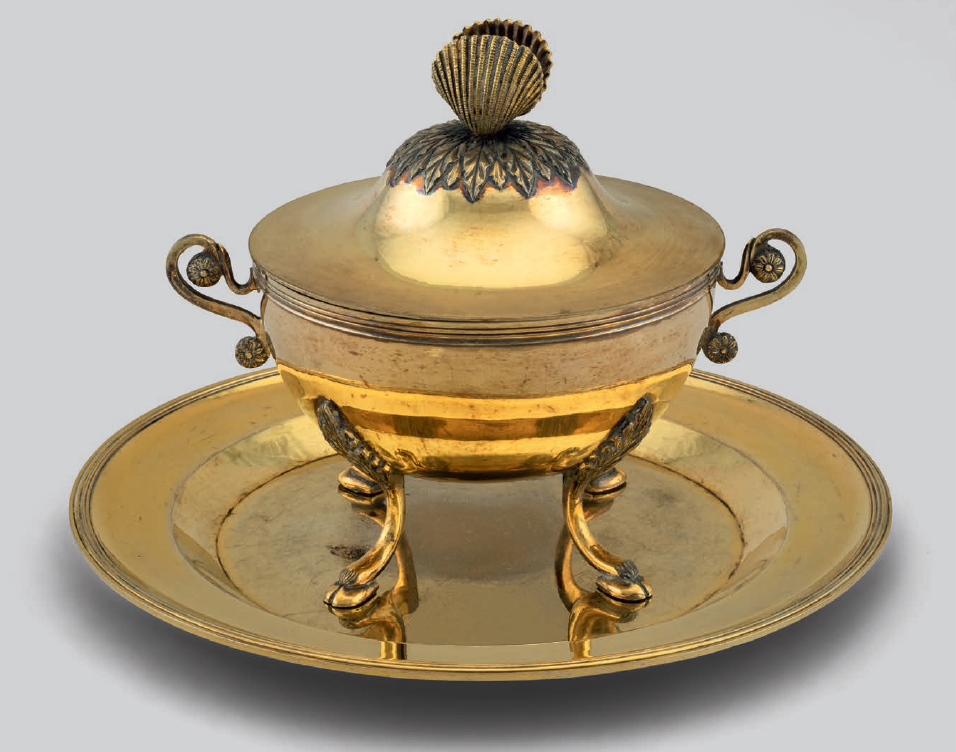
Sugar bowl with plate
Giovanni Enrico Fino
c. 1795-1800
Gilded, chased and engraved silver
diam. 23, 5 cm (piatto);
20 x 15,5 x 14 cm;
peso 1074 g (zuccheriera)
Inv. 0471
Catalogue N. A416
Description
The round, smooth sugar bowl rests on four goat’s feet attached to the body with foliate shields. It has curved handles decorated with rosettes and a domed lid with a knob in the shape of an open shell resting on a base of acanthus leaves shaped like lance heads. The simple, round plate has a moulded rim.
The item, which could also have served as a small tureen, bears the maker’s mark of Giovanni Enrico Fino, one of the most prolific late 18th-century silversmiths. The half-length figure of St John the Evangelist flanked by the attributes of the chalice and the eagle appear on the body of the sugar bowl and on the plate. Fino qualified as a master goldsmith and silversmith in 1762, at the age of twenty-two, and served as head of the guild in 1789 and 1791. Initially oriented towards the French style and the work of Andrea Boucheron, as in the splendid toilette service of gilded silver created in 1775 for the marriage of Marianna of Savoy, daughter of Vittorio Amedeo III, to her paternal uncle Benedetto Maurizio, Duke of Chiablese,1 Fino later specialised in the production of coffee pots with characteristic animalhead spouts, often of a feline form.2 He gradually adapted to the late 18thcentury classicist taste and achieved results of the highest quality. Examples include an elegant coffee pot of c. 1780 adorned with festoons and acanthus leaves, an austere chocolate pot of the same period with subtle beaded decoration,3 and a legume serving dish produced between 1789 and 1793, where rocaille elements like a cherub and garlands are still present alongside others of a Neoclassical nature like stylised leaves and pods.4
The sugar bowl also bears the marks of the assayers Matteo Promis and Giuseppe Fontana, the last to be appointed under the ancien régime in 1787. The fact that Promis employed the mark in use from 1793, when the assay system was changed, to 18035 makes it possible to circumscribe the date of production to c. 1795-1800, a period that coincides perfectly with Fino’s full adoption of the Neoclassical style and the influence of Lombard and Roman silverware.
Clelia Arnaldi di Balme
1 Fina 2002, pp. 54-57.
2 See the one in Palazzo Madama (Turin, Museo Civico d’Arte Antica, inv. no. 291/A); Turin 2012, p. 69, no. 32.
3 Fina 2018, pp. 222-225, no. 86, pp. 226-227, no. 87.
4 A. Griseri, cat. XII.28, in Milan 2002, pp. 232, 503.
5 G. Fina, “‘Università de giojellieri, oreffici et argentieri’. Norme relative alla produzione e al commercio”, in Turin 2012, p. 249.
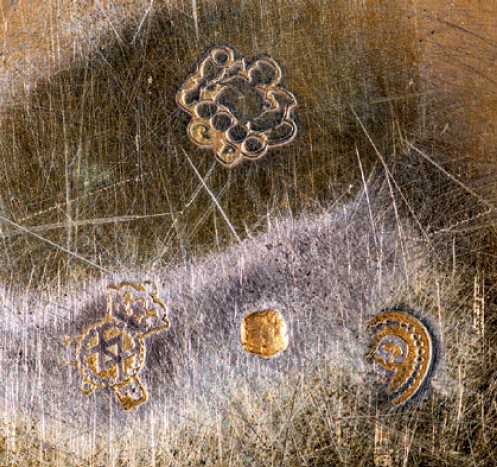
Fig. 1. Silversmith’s mark, first and second assay marks.