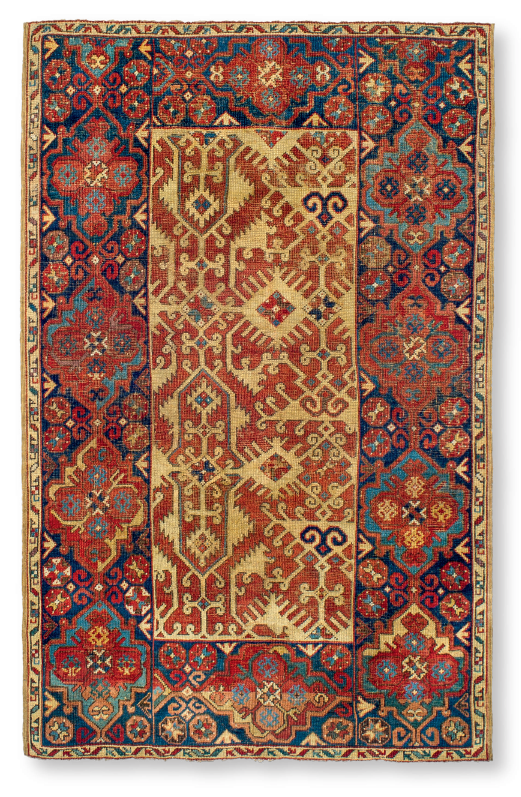
Ushak arabesque rug of the so-called “Lotto” kind
Late 17th century
Woollen pile on woollen warp and weft, symmetrical knots
167 x 115 cm
Inv. 0763
Catalogue N. A686
Though smaller and later than the other “Lotto” carpet in the Cerruti Collection (N. Cat A685), this is in any case a classic specimen of a particular interest. It belongs to what is known as the Transylvanian group due to the fact that many are to be found in the evangelical churches of that region. The arabesque design is much more geometric and stylised than in the other and exemplifies what is conventionally known as the Kilim style. The difference lies above all in the proportions, with broad borders and a somewhat cramped field. The design inside the field, which represents a section of the typical “Lotto” motif, displays some asymmetry and lack of balance but the carpet still retains its age-old charm, albeit slightly impaired by major restoration work. The broad dark blue border contains a pattern of alternating coloured cartouches, the most classical motif of the period, and is accompanied by a small outer guard with a yellow ground but no inner guard at all. One singular feature of this carpet that makes it particularly interesting is the fact that the vertical borders are complete and cut the horizontal, contrary to what normally happens. As is known, these small Anatolian rugs of the Ottoman period practically never had resolved corners but were instead woven starting from the bottom horizontal border, which occupied the entire width of the loom, and then starting anew with the vertical borders with no concern about the continuity of the design and the corners thus created. Here, instead, as in very few other specimens, priority is accorded to the vertical borders.
Alberto Boralevi