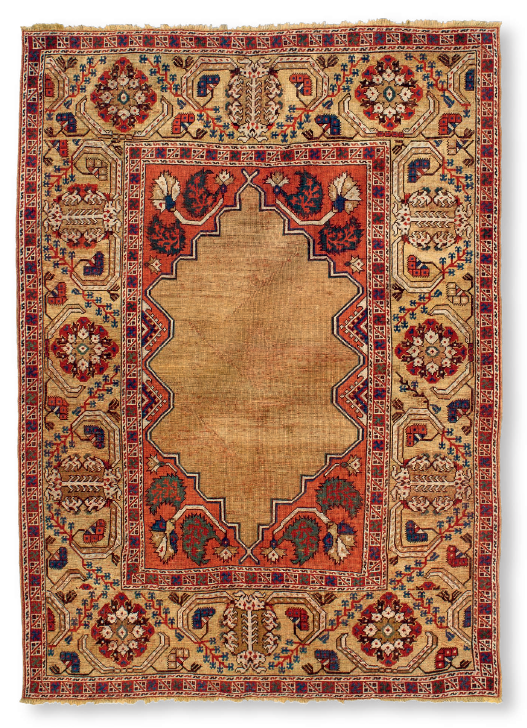
Double-niche Transylvanian rug with plain field
Second half of the 17th century
Woollen pile on woollen warp and weft, symmetrical knots
168 x 126 cm
Acquisition year 2011
Inv. 0764
Catalogue N. A687
Provenance
The term “Transylvanian” is used for certain Turkish rugs of the Ottoman period dating from the late 16th century and the first half of the 17th. This is due to the survival of a few hundred specimens in the Lutheran churches of the German (Saxon) population settled in this region, now part of Romania. They are generally small rugs imported into Transylvania in such large quantities that they were initially thought to have been woven locally or in neighbouring territories of the Balkan area under the rule of the Ottoman Empire. While this supposition is now rejected by all scholars, some types of design are unquestionably far more frequent among the rugs preserved in Transylvania than anywhere else in the world including Turkey. These consist mainly of “double-niche” rugs as well as some “single-niche” specimens and “prayer rugs”, including in particular some with an architectural column motif, in addition to the “Lotto” rugs with arabesques, the “Holbein” rugs and the white rugs with “bird” and cintamani motifs. The Cerruti Collection includes three double-niche rugs, of which this is probably the best-preserved and the finest despite the simplicity of the design on a plain golden yellow field.
It should be pointed out that like “Tintoretto”, “double-niche” is a conventional term, deriving in this case from the fact that the design of the central field appears to be generated by symmetrical mirroring of the prayer niche (mihrab) motif. As prayer rugs were, in fact, woven with a directional design for orientation towards Mecca, the term “double-niche”, that is, two-directional, would make little sense even though in many cases, including this one, the directionality is actually imparted by the design of the border, which is all orientated in the same direction. While the rugs of this family are mostly on a red ground, various examples are known with a golden yellow ground, as in this case, which appears to be very finely drawn and symmetrical. Rugs with a completely plain field like this one - and unlike the other two in the collection (N. Cat. A689 and A690), which present various kinds of decoration - are instead quite rare. Of the few known in Transylvania, the one in the Black Church of Brashov is almost identical to the Cerruti rug.1 The serrated profile of the double-niche central field is perfectly symmetrical and well-proportioned. It does not touch the borders but seems to float on the ground of coral red. The spandrels contain arched leaves and stylised carnations derived from the grand style of the Ottoman court but translated here into a simpler and more vernacular language. The same holds for the border with rosettes and rounded palmettes (often described as pine cones or even pineapples) combined with sickle-shaped leaves of a slightly stiff and stylised nature. On the basis of some similarities of design and the range of colours, rugs of this kind are sometimes compared to those produced at Melas in the 18th and 19th centuries even though they are more likely to come from the area of Ushak, like most of the “Transylvanian” rugs.
Alberto Boralevi
1 Inv. no. 222, published in Ionescu 2005, p. 137, no. 136.