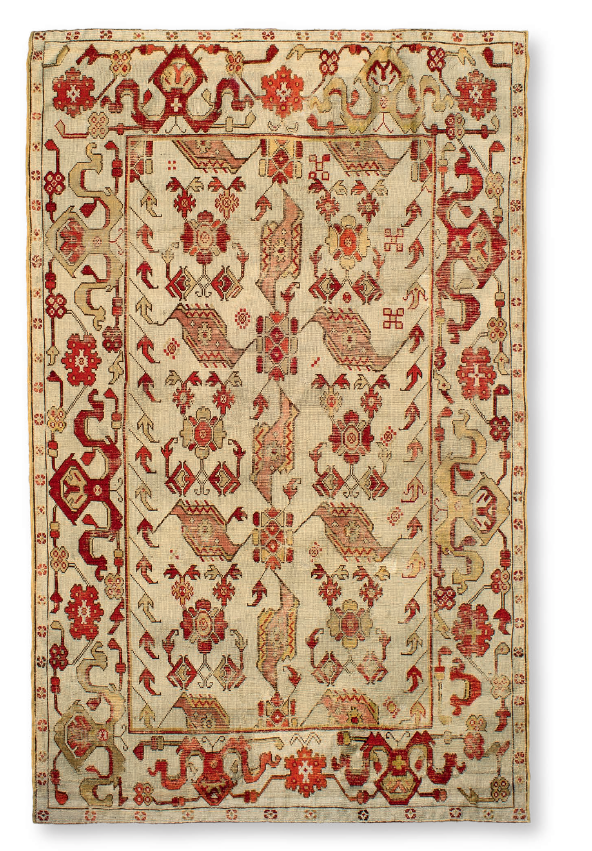
Selendi carpet with “bird” motif
First half of the 17th century
Woollen pile on woollen warp and weft, symmetrical knots
191 x 129 cm
Inv. 0758
Catalogue N. A681
These carpets with an ivory-white ground and particular range of colours are very rare and found today above all amongst those donated to Protestant churches in Transylvania and kept there for centuries. With few exceptions, they present essentially two designs, namely the “bird” motif, as in this case, and the small circles known as cintamani, in fashion at the Ottoman court as from the 16th century. There are today only four known example of a third “scorpion” design, two of which still in churches in Transylvania.
They were once all regarded as Ushak but, unlike the typical carpets of that area, these have an undyed, ivory-coloured weft rather than a red ground. It has also been established that they were woven in the small town of Selendi, not far from Ushak, on the basis of a 17th-century archival document that refers to carpets produced there as white with “crow” and “leopard” motifs.1 The specimens that correspond to this description are therefore known today as Selendi. The term “bird” motif is still used even though the experts now unanimously agree that they are not in fact birds but stylised leaves forming a lattice of squares around circular flowers or rosettes. This particular design has been compared to an almost identical motif in a softer and more curvilinear style found on some of the Iznik tiles that adorn the interior of the Rüstem Pasha mosque in Istanbul. Similar comparisons can also be made with fabrics of the period. It therefore appears evident that this motif was developed in the court workshop and then went its own way, circulating in rugs made for export as early as the second half of the 16th century, as attested by their depiction in paintings such as Hans Muelich’s Portrait of a Protestant Doctor of Laws (c. 1557, Washington DC, National Gallery of Art, Kress Collection) and the early 17th-century Eumenes and Roxana by Padovanino (Alessandro Varotari) in the Hermitage, Saint Petersburg (fig. 1). The quality of the weaving varies greatly in relation to period and size. While the larger and earlier specimens have a broader chromatic range of up to seven different colours, the smaller and later ones normally present only three or four.
The Cerruti carpet is from a good period and presents a particularly well-drawn design, unlike the later specimens, which are often far more approximative and confused with “bird” motifs that become amorphous and almost unrecognisable. There are seven different colours, all of them light, and the cloudband border is very well designed and proportioned, similar to those of identical design but different colours often found also in Ushak “Tintoretto” carpets (including one in the Cerruti Collection, cat. p. 1020) and in the “Lotto” rugs of the Transylvanian group.
Alberto Boralevi
1 The document, dated 1640, is a list of the highest prices applicable for certain carpets, in which reference is made to prayer rugs in the Selendi style with the leopard motif (pelengnaḳş) and Selendi white-ground carpets for Turkish baths (hamam) with the crow design (karga nakişlu). See Inalcik 1986, pp. 58-59.
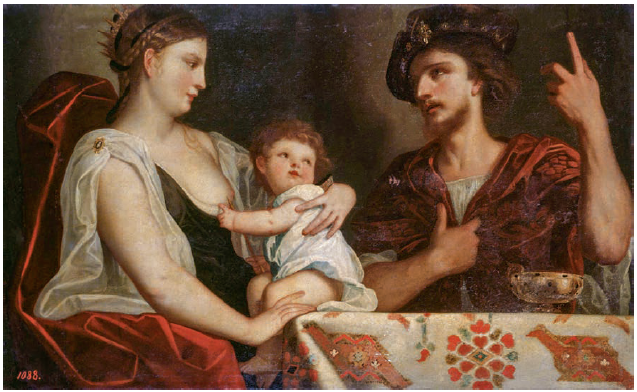
Fig. 1. Padovanino, Eumenes and Roxana, 1630-39. Saint Petersburg, The State Hermitage Museum.