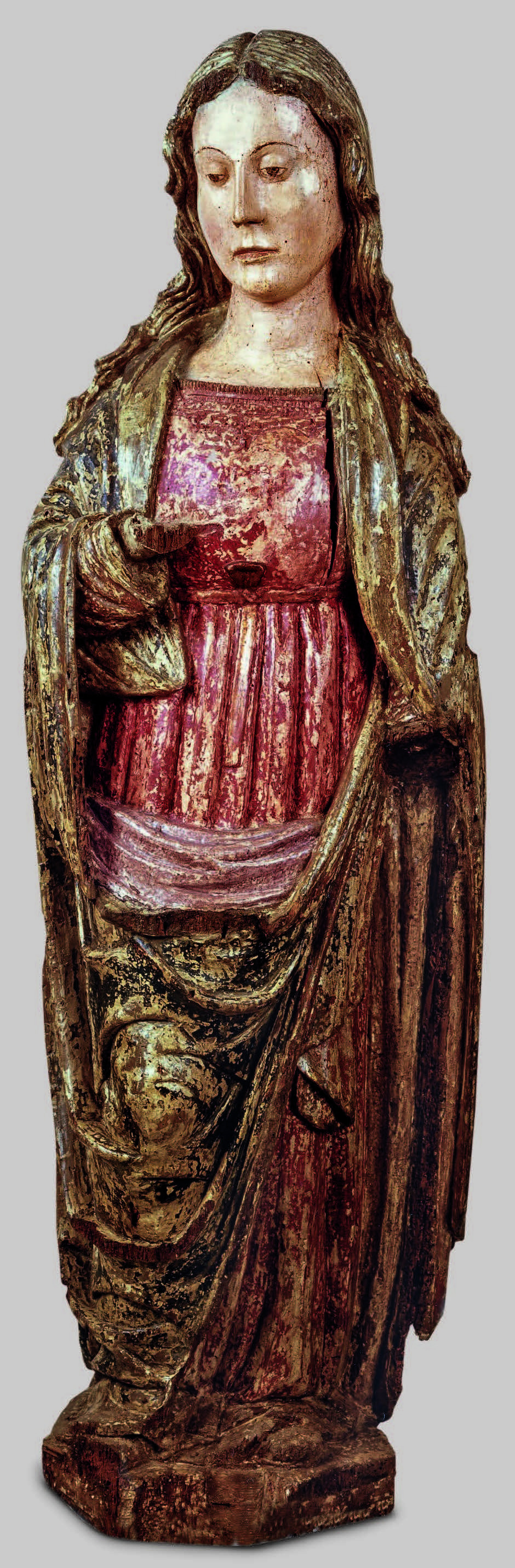
Female saint (Mary Magdalene?)
Lombard Sculptor
Late 15th-early 16th century
Carved, painted and gilded wood
119 x 27 x 25 cm
Acquisition year ante 1983
Inv. 0802
Catalogue N. A744
This sculpture shows clear signs of the damage it has undergone over its long history. Xylophagous insect damage is combined with mutilations (both hands are missing, among other things) and fragmented paintwork. Although the colour is generally quite well preserved on the young saint’s long hair and face, the same cannot be said for the reddish tint of her dress and for her cloak, which is missing much of its original hue. The figure, carved from a trunk of wood that has been hollowed out and plugged from the back, stands on a low hexagonal pedestal that is consistent with the carving and from the same period. The base has undergone significant damage, particularly at the front. The loss of the hands prevents us from discovering which attribute was very probably held by the Female Saint, which would have been useful for clearing up any doubts regarding her identification. Despite this, her red dress and long hair - carved persistently into waves, even at the back - would seem to identify her as Mary Magdalene.
It has not been possible to find any information that would help reconstruct the history of the statue before it entered the Cerruti Collection. Unknown to studies until today, its characteristics strongly evoke woodwork produced in Lombardy during the Sforza period. Over her closely fitting tunic - drawn in at the waist by a knotted belt and with tablet decoration around the square neckline - she wears a voluminous cloak that covers her body, enveloping it and forming superficial creases (especially over her flexed right knee), in keeping with figurative customs typical of Lombard sculpture in wood and marble from at least the 1470s onwards. This specific cultural setting is also evoked by the rather insipid handling of the subject and the figure’s features: her full, oval face culminating in a rounded, protruding chin, her thin and slightly open lips, her straight, pointed noise, and her small painted eyes that emerge from swollen eye sockets.
It is therefore tempting to identify the work’s origins in a geographical area and at a date not too dissimilar to those of the carving of the Dead Christ Supported by Angels also in the Cerruti Collection, which has been convincingly attributed to the carver Giacomo del Maino for some time (cat. p. 436). Nevertheless, the style and quality are of a completely different standard to the works produced in the major workshop run by the Del Maino family, which was handed down from Giacomo to his sons Giovan Angelo and Tiburzio. Nor is it possible to ascribe it to the exponents of the other main Lombard workshop active at around the same period, run by the De Donati family. Lastly, as regards the production of the Milanese sculptor Pietro Bussolo, who also worked in the Bergamo area, there are some similarities and common features, but these are not sufficient to justify attributing this probable Mary Magdalene in the Cerruti Collection to his hand.1
For the moment at least, the creator of the statue in Rivoli is destined to remain nameless. However, we can state that he worked diligently, standing out for his scrupulous albeit slightly rigid processing of the surfaces, as is particularly apparent in the rendering of the fabrics, which lack their natural consistency and have been transformed into stiffly wrinkled cloth, and the rendering of the hair, which falls in a mechanical succession of undulating locks that are not lacking in decorative effect. When looking for comparisons that could be helpful in pinpointing the background of this carving, I believe we can certainly look to the Lamentation Over the Dead Christ in the church of San Giorgio in Gropello Cairoli (Pavia), whose figures with their full faces and rigid clothing, and also certain ornamental details on their apparel (the finish of the hems and the soft knots of the belts that fasten them), reveal a definite similarity to the statue in question. The group in Gropello Cairoli has been tentatively dated to between the late 15th and early 16th century and is deemed to have come from somewhere in the Brescia area.2 This interpretation could also extend to this sculpture. Furthermore, the more widely discussed Madonna Enthroned from a private collection and assigned by Raffaele Casciaro to the versatile artist Maffeo Olivieri,3 has also been attributed to that area. In this case, the construction of the face shows very telling similarities to that of the Female Saint in the Cerruti Collection.
Federica Siddi
1 As regards these masters, in addition to the reflections put forward by Casciaro 2000, passim, it is also worth considering, with previous bibliography: M. Albertario, “Intorno a Giovanni Angelo del Maino”, in Milan 2005-06, pp. 159-171; Tasso 2009; Bergamo 2016; Albertario 2017.
2 Raffaele Casciaro (2000, pp. 102-105) had initially attributed the group to Maffeo Olivieri, dating it to the early 16th century. The scholar then reviewed both the date and the attribution, opting for an anonymous master, albeit one linked to Brescia and active between the late 15th and early 16th century: R. Casciaro, “Qualche spunto vigevanese per la storia della scultura in legno”, in Giordano 2007, pp. 26-27, 206-207. For a different interpretation, with previous bibliography, see now: M. Albertario, in Vigevano 2009, pp. 146-147, cat. 33; see also A. Casati, in Dionigi, Ferro 2020, pp. 183-184, cat. 31.
3 Casciaro 2000, p. 105.