Psalter-Hymnal
Nuremberg
Last quarter of the 15th century
180 x 135 mm
Inv. 0694
Catalogue N. A618
Description

Psalter-Hymnal, Nuremberg, last quarter of the 15th century
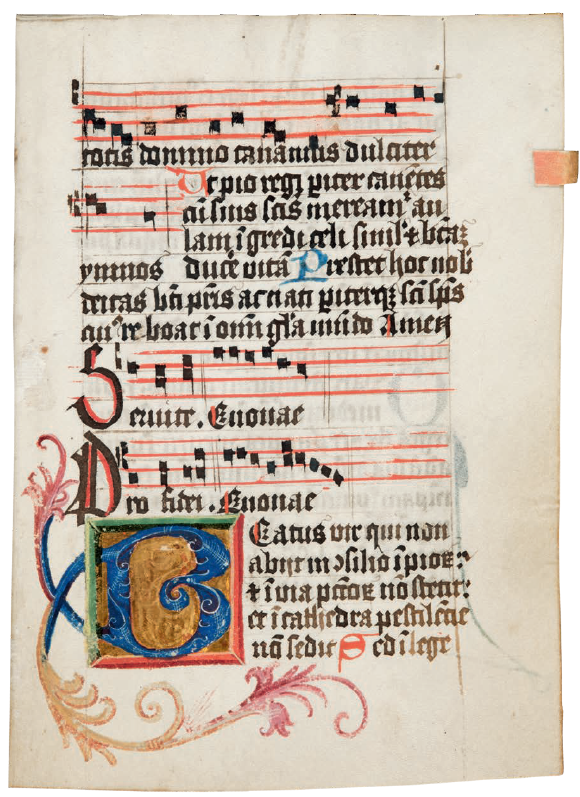
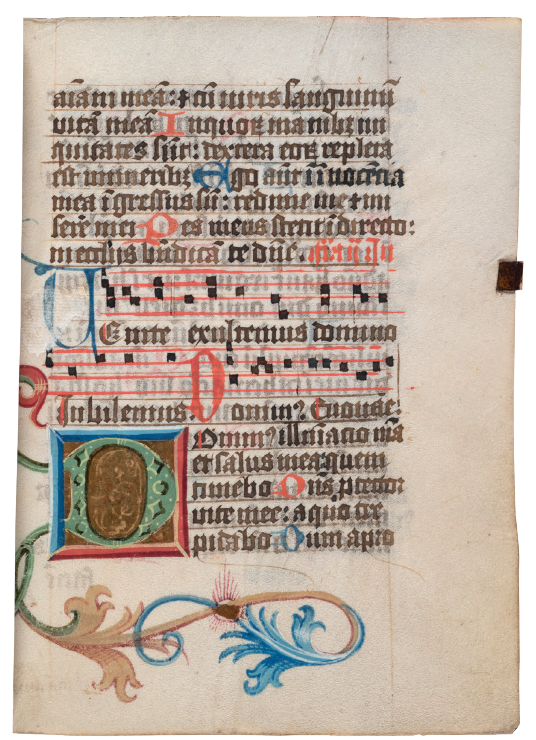
This manuscript contains a Psalter/ Hymnal, namely a book for the Liturgy of the Hours that combines Psalms and hymns arranged on the basis of their use in the various Hours of the individual days of the week; they are supplemented by antiphons and invitatories with square musical notation. In an unusual fashion, the Pater noster and Credo have been brought forward to the beginning of the manuscript, while the Psalms are followed by the canticles of the Old and New Testament, followed by Te Deum, the Canticle of Zechariah (Benedictus) and the Athanasian Creed (Quicumque vult).
The text is dotted with ornamental initials, enclosed by gold frames, out of which colourful foliage unfurls in the margins of the manuscript with acanthus-style leaves and thin and sharp white highlights. These forms, which represent an evolution of the “Schöner Stil”, connect the manuscript to the workshop of the socalled “Kobergermeister”.1 Active in Nuremberg, he worked with the printer Anton Koberger (1440/1445-1515),2 from whom he took his name. Square musical notation was not commonplace in this context: with the exception of manuscripts belonging to the mendicant orders, or those associated with the reformed monasteries, liturgical books from south-east Germany usually tended to adopt Germanic Gothic notation. The manuscript must soon have found its way to Moravia, given that the contemporary binding has been recognised as coming from the workshop active at the Olomouc charterhouse,3 documented between 1470 and 1534.4
Fabrizio Crivello
1 Pfändtner 2009a, pp. 253-270; Id. 2009b, pp. 60-62.
2 Nuremberg 2013.
3 Collezione Cerruti 2016, p. 201, no. 442.
4 J. Glonek, “Knihvazačská dílna olomouckých kartuziánů”, in Krušinský, Vintrová 2013, pp. 40-61.