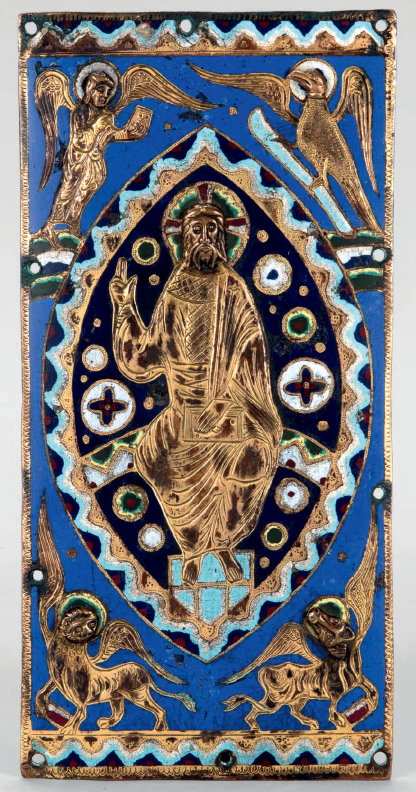
Binding plate with Christ in Majesty
Goldsmith from Limoges and modern interventions
1190-1200; 19th and 20th century
Engraved and gilded copper; chased and gilded bronze alloy; champlevé enamelling in dark blue, blue, turquoise, dark green, pale green, yellow, red and white
20 x 9,5 cm
Inv. 0616
Catalogue N. A544b
The medallion features a hybrid creature: a winged ape with the lower part of its body covered in scales (like a reptile). The tail ends in a fleuron, namely a three-petalled flower, with a spray of plants trailing out of it and covering the bottom of the relief. The ape grips on to this flowery branch, which derives from the motif of the inhabited spray of Romanesque origin: it seizes it with its right hand and wraps its left arm around it. The border, decorated with enamel, features a pattern of small tripartite leaves in metal left bare.
The medallion belongs to the famous 19th-century series of the choir of the church of San Sebastiano in Biella, whose complex history is an important testimony to the esteem in which the Middle Ages was held in Europe in the second half of the 1800s. The reredos of the choir, produced in 1546, were embellished at the time with a series of medallions depicting fantastic animals, in gilded copper and champlevé enamelling. These medallions were made in Limoges in the first quarter of the 13th century and came from one of the precious treasure chests of Cardinal Guala Bicchieri from Vercelli (c. 1160-1227).1 One of them featured a winged ape, as documented by a positive cast produced in around 1870 and still preserved today (Biella, Liceo Classico Giuseppe e Quintino Sella, Museo). After this date, the medieval medallions attached to the choir were detached, taken away and dispersed on the antiques market in Italy and France. The medallion with the iconographic subject of interest here found its way, after various changes of hands, to the Ernst Kofler-Truniger Collection in Lucerne, and then to the Keir Collection in London. When this latter collection was auctioned off (1997),2 all traces of the work were lost and its current location is unknown. However, prior to the sale, artisans from the Scuole Professionali in Biella, based in the abbey of San Sebastiano at the time, produced copies of all the original medallions, which were then attached to the reredos in the spaces left empty by the 13th-century pieces. We currently know of four examples featuring the winged ape, all deriving from the original formerly in the Keir Collection: the one currently in situ in Biella, a medallion at the Museum für Kunst und Külturgeschichte in Dortmund (inv. no. 1963, no. 3), one at the Bohdan and Varvara Khanenko National Museum of Arts in Kiev and, lastly, the one that has now emerged in the collections of Francesco Federico Cerruti. As discovered by the diagnostic investigations using X-ray fluorescence and carried out by the University of Turin,3 both the medallion now in Biella and the one in the Cerruti Collection are 19thcentury creations: this is confirmed by the chemical composition of the enamel (with quantities of lead and cobalt incompatible with the characteristics of the medieval enamel from Limoges and the significant presence of arsenic, a component unknown in the Middle Ages), and the type of gilding, which does not use mercury but is carried out with an electrochemical process instead. The artisans from the Scuole Professionali in Biella started by making plaster casts of the 13th-century originals, before using these moulds to cast the copies that still survive today. As well as being exact reproductions of the original model (namely the medallion formerly in the Keir Collection, which once belonged to Guala Bicchieri), they are completely identical.4 The revival of the medieval technique of champlevé enamelling, the sale of the whole set of the 13th-century medallions and their circulation across Europe (seven of them found their way to the Museo Civico d’Arte Antica in Turin, twelve to the Louvre in Paris and two single pieces to the Metropolitan Museum in New York) all demonstrate the great esteem in which late 19th-century private collectors held medieval objets d’art: such as metalwork, enamelware from Limoges, ivory, glass, leather and metal artefacts.
The collecting history of the medallion still needs to be reconstructed. Purchased at an antiques fair, as recalled by Francesco Federico Cerruti’s assistant Annalisa Polesello Ferrari, it probably entered the collection in around the mid-1990s, as demonstrated by photographs of the villa interiors that show it on display in the study, above Giovanni Battista Galletti’s drop-leaf secretary desk (cat. p. 988).
Simonetta Castronovo
1 Castronovo 2014, pp. 118-135.
2 The Keir Collection 1997, lot 41, p. 58.
3 To this regard see Agostino 2021, pp. 5-6.
4 The only difference that can be observed between the four objects regards the external finish of the border, in smooth metal: in fact, in the examples in Biella, Dortmund and Kiev it features an engraved hatched pattern, which is absent from the medallion in question here.