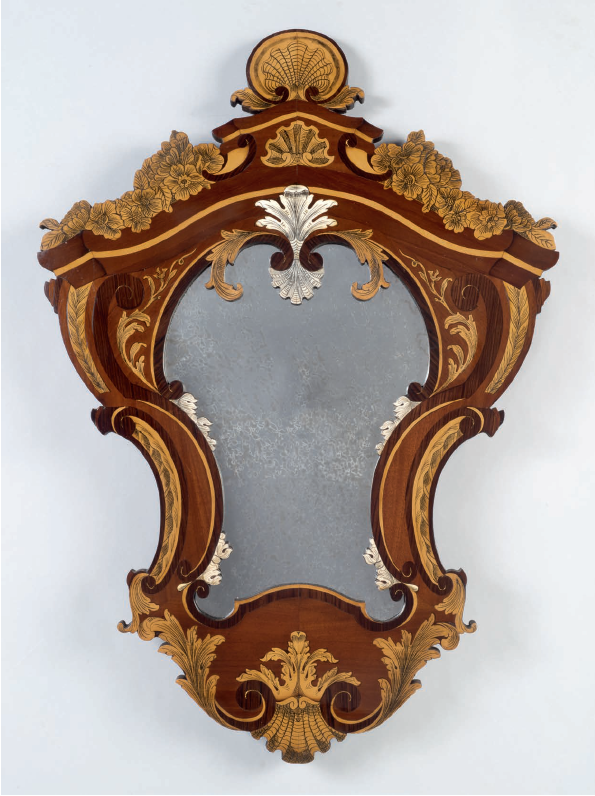
Small Mirror
Giovanni Galletti (attributed)
55,5 x 40 x 1,7 cm
Inv. 0341
Catalogue N. A296
Description
Provenance
Exhibitions
The structure is poplar and the veneering of purpleheart, palisander, boxwood and engraved ivory. The shield-shaped mirror has a cornice with a garland of flowers on either side of an inlaid shell surmounted by a prominent circular element containing another cockle shell. A third cockle shell, turned upside-down, is found at the bottom. The back of the mirror was polished in a later period.
It has been published twice by the present author,1 who, however, did not have the opportunity to thoroughly examine it. New elements have now emerged from a more fully documented study.
The writing in ink on the back is not the cabinetmaker’s autograph signature, as established by comparison with the unquestionably authentic ones written at the bottom of receipts for payment. No trace of the mirror is to be found in the records known so far of payments made to Galletti by the House of Savoy, including those published by Giancarlo Ferraris2 and the further records made known by the present author. Such cases are, however, not infrequent.
More serious is the fact that the Dotazione della Corona inventory numbers stamped on the back correspond to nothing in the Inventari dei Reali Palazzi now in the Turin State Archives. Meticulous research was carried out by Chiara Accornero for the purposes of this study on eight inventories of Palazzo Reale in Turin, starting with the year 1807, four of the Castle of Moncalieri and two of Venaria-La Mandria. The numbers printed on the back of the mirror either do not exist or correspond to different items.
In conclusion, until proven otherwise, both the signature and the stamps are to be regarded as not original and the attribution to Galletti as highly problematic. The mirror displays neither the fresh vein of inventiveness on which the cabinetmaker drew up to just a few years earlier in the Stupinigi desk and tables (1775 and 1776) nor any hint of the Neoclassicism then gaining ground in Turin, an example of which Galletti was to produce three years later in the secretary desk for Vittorio Amedeo III now in Palazzo Reale in Genoa (1784).
A point of stylistic reference for the marquetry is to be found in the dressing-table mirror in Palazzo Madama (inv. no. 1448/L), attributed by Arturo Midana and Vittorio Viale to Piffetti and by Luigi Mallé to his workshop.3 The shape is similar to that of a table mirror by Boulle for the Duchess of Berry in the Wallace Collection. Another of similar shape is in the Rothschild Collection at Waddesdon Manor.
As attested by the paper label, the Cerruti mirror was formerly owned by Anna Bonomi Bolchini (1910-2003), the head of a family building, industrial and financial empire in Milan, some of whose furniture was subsequently auctioned. It should be noted that Bonomi Bolchini’s properties included the Villa dei Laghi in the park of La Mandria, purchased from the Medici del Vascello family in 1980. Both the exterior and the interiors of this 19th-century building were radically renovated by the architect Renzo Mongiardino and refurnished. (The earlier furniture still consisted mostly of items produced by Gabriele Capello for Vittorio Emanuele II.) The Bonomi Bolchini family owned the property until 1995, when it was taken over by the Region of Piedmont within the framework of the public purchase of the estate of La Mandria. This could supply some clue to account for the presence of the mirror in the Bonomi Bolchini Collection.
Roberto Antonetto
1 Antonetto 2010, vol. I, p. 290; Venaria Reale 2018, pp. 245-246.
2 Ferraris 1992, pp. 231-247.
3 Midana 1924, p. 172, fig. 322; Turin 1963a, vol. III, p. 24, no. 44 and pl. 49a; Mallé 1972, p. 159 and fig. 240.