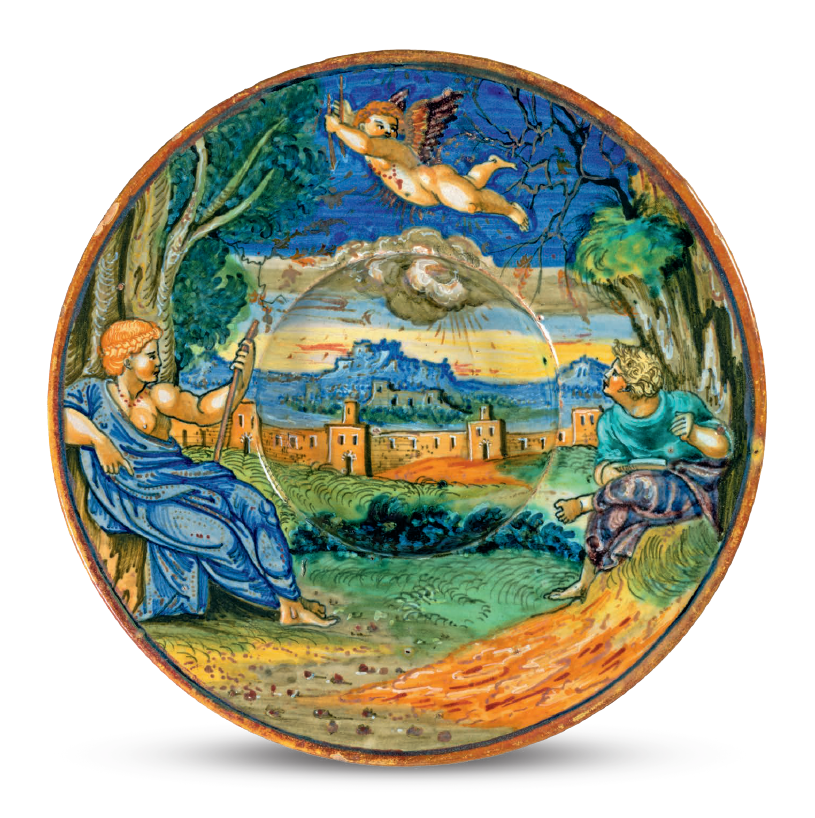
Plate “tondino” with an allegorical or mythological scene
Francesco Xanto Avelli
Urbino
1531
Maiolica with golden and red lustre
diam. 20 x 3,5 cm
Inv. 0615
Catalogue N. A545
Description
The plate is decorated with two seated figures, one male with a book on his knee and the other female with a stick in her left hand, in a landscape with a stretch of city wall running through it. High in the sky Cupid is painted in flight with two arrows in his hand. The tondino is a small plate, with a deep recess and wide rim. This was one of the forms favoured by Francesco Xanto Avelli, who painted dozens of examples. All three figures are drawn from an engraving by Marcantonio Raimondi of the Raphael fresco of Parnassus in the Vatican (Room of the Segnatura), a print repeatedly used by Xanto in his abundant production. The changes made by Xanto regard the substitution of Cupid’s laurel crowns with two arrows and Muse’s trumpet with a staff, as well as the absence of a pen in the young man’s hand.
The subject of the plate is not indicated in a key on the back, as is often the case in Xanto’s works: we can theorise that it is a mythological scene or an allegorical representation. The arrows in Cupid’s hands seem to indicate he is about to spark love between the man and the woman.
Xanto was born in Rovigo but moved to Urbino some time before 1530, when he is documented there for the first time. One of the most interesting figures in the history of Renaissance maiolica, he was also a poet and composed some sonnets for the Duke of Urbino. He never had a workshop of his own but was an extremely prolific painter, as attested by over 420 surviving known works. The majority of them (over 300) are signed, which is truly exceptional for a maiolica painter. He made abundant and very free use in his work of prints then circulating on the market, especially those of Marcantonio Raimondi and the school of Raphael.1
Between 1524 and 1525 and then between 1528 and 1529, some of the plates attributable to Xanto were lustred and stamped in the workshop of Maestro Giorgio in Gubbio. Giorgio Andreoli, also originally from northern Italy, had specialised some time earlier in gold and red lustre decoration, a technique of Islamic origin that made it possible to add iridescent reflections to maiolica that had already been painted and fired, thanks to the use of metal oxides (copper and silver) and firing at a low temperature in a reducing atmosphere. The theory has been put forward that the plates featuring the stamp of Maestro Giorgio’s workshop were painted by Xanto directing in the workshop in Gubbio, rather than painted in Urbino and transported to Gubbio to be lustred. However, in the case of the plate in the Cerruti Collection, as in the case of other works from the 1530s, the plate is signed by Xanto as painted in Urbino and the question remains open as to whether the lustre was added in Urbino or Gubbio. In any case, 1531 was the year when Xanto began signing his works on a regular basis and with the attribute “rovigiense” (from Rovigo). One third of the works he produced during that year are lustred.
Cristina Maritano
1 Mallet 2007; J. V. G. Mallet, “Nicola da Urbino and Francesco Xanto Avelli”, in Xanto 2007, pp. 199- 250; E. Sani, “Per un catalogo delle opere attribuibili a Xanto: una ricognizione della sua produttibilità e sul suo complesso apparato figurativo, linguistico ed erudito”, in Xanto 2007, pp. 181-198; Wilson T. 2018, pp. 217ff.
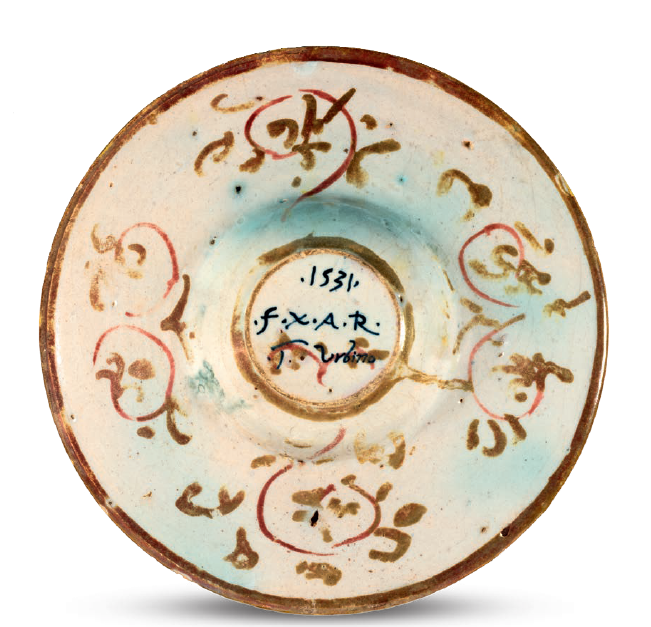
Fig. 1. The back of the plate.