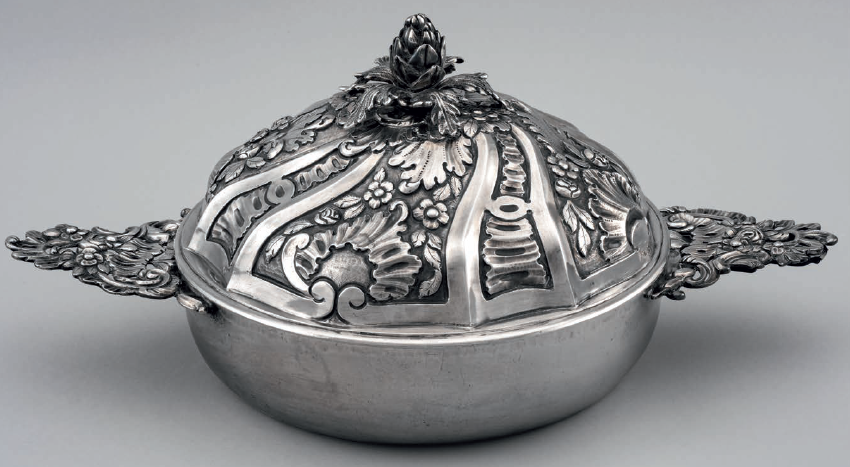
Childbirth bowl
Gabriel Marcello Giuliano
c. 1770-1775
Repoussé, chased and engraved silver
12,5 x 28 cm;
diam. 16 cm;
peso 790 g
Inv. 0470
Catalogue N. A415
Description
Provenance
Bibliography
Sometimes listed in inventories of the period as a scudella (from the French écuelle), the paiola was not just a bowl but a precious gift from a husband to a wife after she had given birth and was in need of broth to regain her strength. This childbirth bowl has a lid divided by spiral ribbing into four compartments, which contain leaves in a fan-like array and flowers, and a knob shaped like an artichoke. Rocaille volutes alternate with flowers and rosettes on the openwork handles. The hallmark with the cross bottony of St Maurice between two palm leaves and the initials “GG” belong to Gabriel Marcello Giuliano, born into an established family of goldsmiths active since the 1720s, who qualified as a master in 1760.1 Trained by his father Giovan Battista and uncle Giuseppe, he kept the same hallmark, not least because there was no need to change the initials. His work was greatly esteemed, as attested by the fact that he was granted the honour of displaying the royal arms outside his workshop in 1780.
Giuliano was still active in 1793, according to the records of the Turin census. His surviving works comprise a pair of round tureens, several childbirth bowls and sugar bowls,2 and a set of elegant frames for altar cards from the collegiate church of San Lorenzo Martire in Giaveno (Turin, Museo Diocesano), for which he worked repeatedly during the 1770s and 1780s.3 Lost, instead, are the objects produced in 1771 for the church of Corpus Domini in Turin and the sunburst monstrance with the emblem of the Holy Spirit and the Coronation of the Virgin produced in 1777 for the church of the Spirito Santo in Susa, which was stolen by the French in 1799.4
In addition to the Giuliano maker’s mark, the elegant and exquisite paiola bears the assay marks of Carlo Micha, active from 1759 al 1787. A dating of 1770-75 can be suggested on the basis of similarities with a paiola with a knob in the shape of a palm leaf dated around 1765,5 from which it differs in its more swirling lines and the accentuated threedimensionality of the decoration and the perforated handles. It is also similar in the lightness of its lines to the childbirth bowls attributed to Giovanni Giuseppe Valle, active until 1793.6
Clelia Arnaldi di Balme
1 L. Mana, “Elenco biografico degli argentieri presenti in questo volume”, in Turin 2012, p. 232.
2 Fina 2002, pp. 77-81.
3 N. Maffioli, cat. 44, in Cervellin, Maffioli 2011, pp. 126-127.
4 M. P. Ruffino, cat. 26, in Bertolotto, Amprino 1998, pp. 104-105.
5 Fina 2002, p. 78.
6 Ibid., especially the one on p. 117, dated around 1775.
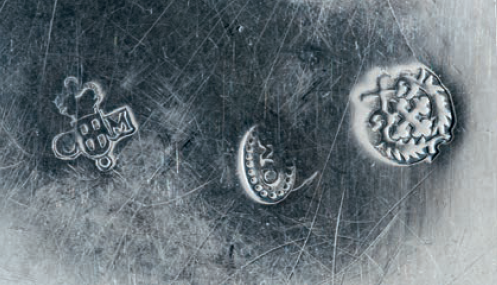
Fig. 1. First and second assay marks and mark of the silversmith.