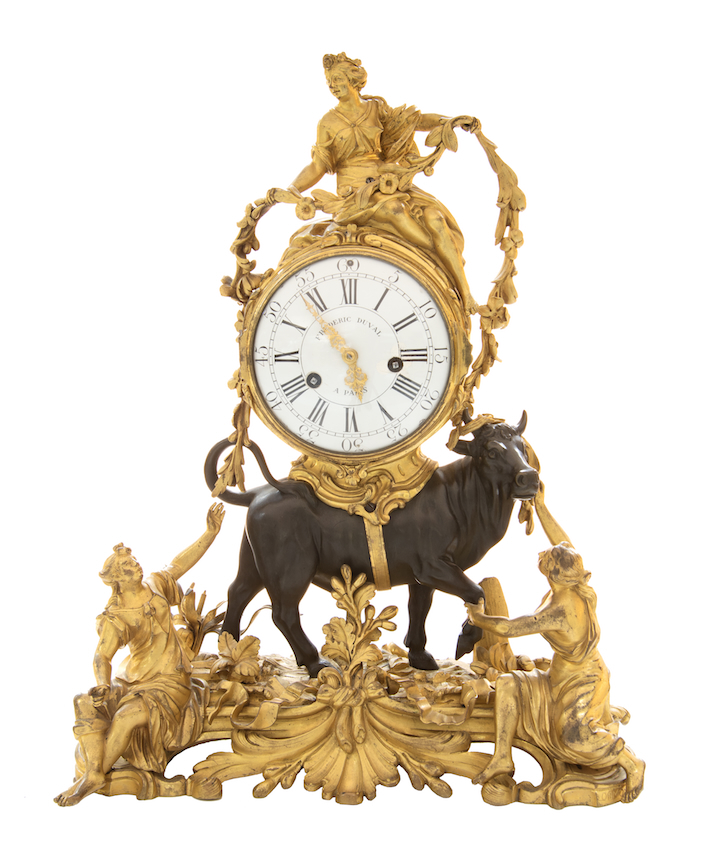
Mantel clock with the abduction of Europa
1755-1760
Gilded bronze, burnished bronze and enamel
48 x 38 x 20 cm
Inv. 0430
Catalogue N. A381
Description
Bibliography
The round dial rests on the back of a bull and is presented by three female figures in a riot of ribbons and flowery garlands. The scene alludes to the myth of Europa, daughter of King Agenore. Zeus saw the princess bathing with her handmaidens on the Phoenician shore and fell in love with her. So as not to frighten the young women, he assumed the form of a white bull grazing in the meadow, so docile that they began to stroke him and Europa climbed onto his back. The bull immediately leapt into the sea and swam all the way to the island of Crete, where he regained his own form, declared his love and brought the Horae or Hours, his handmaidens, down from the heavens. Minos, Rhadamanthys and Sarpedon were born out of their union.
The subject enjoyed great popularity in painting as from the 16th century with depictions by Titian and Paolo Veronese followed by Tiepolo and Sebastiano Ricci. The early 18th century saw bucolic versions of the utmost buoyancy by a host of French artists, including Jean-François De Troy, François Boucher and Nöel Nicolas Coypel, and the subject’s interesting potential was also exploited in the decorative arts.1
The dial is signed by Frédéric Duval, an apprentice of François Béliard in Paris documented in Rue Mazarine in 1778 and in Rue Jacob as from 1781. Duval used cases by the finest French bronzeurs of the period, including Saint Germain, Morlay, Poisson and Osmond. The signature “Osmond” refers to Robert Osmond (1711-89), born in Canisy in 1711, who became a master bronzeur in Paris in 1746. His business enjoyed great success and moved to Rue Macon in 1761. Robert’s nephew Jean-Baptiste Osmond (1742 – post 1790) worked with him and it is not always easy to tell their work apart. Robert retired in 1775 and died in 1789, while Jean-Baptiste ran into financial difficulties and went out of business in 1784. The Osmond workshop produced objectsin the rocaille style during the 1760s but switched to the more modern Neoclassical in the following decade.
The markedly rocaille style of the Abduction of Europa places it in the initial phase of Robert Osmond’s career around 1755-60. The bull is a reproduction of a classically-inspired model by Giambologna and the composition enjoyed great popularity, giving rise to clocks supported by elephants, rhinoceroses, bears, horses, camels and other animals. Various clocks similar to the one in the Cerruti Collection are known and at least four of them have the Osmond signature stamped on the base: one with a marble base and movement by Viger included in the sale of the collection of Lucien Surmont in Paris in 1912,2 one with a Viger movement included in the sale of the collection of Madame de Polès in 1936,3 one in the collection of Edward Arnold with a movement by Boucher,4 and one signed by Robert Osmond in the Royal Collections at Windsor Castle (inv. no. RCIN 30424).5 There is also a clock with the partial signature “OS” at the Schloss Johannisburg in Aschaffenburg.6
Items very similar to the Cerruti clock but without the Osmond signature include one of c. 1763 in the Getty Museum, Los Angeles, with a case attributed to Robert Osmond and a movement by Étienne II Le Noir and his son Pierre Étienne Le Noir (inv. no. 73.DB.85),7 one at the Nymphenburg in Munich with a movement signed “Millot horloger du Roy à Paris”, one signed “St. Germain” with a dial by Gilles l’Aîné in the Louvre (inv. no. OA 5168),8 one bearing the signatures of Saint Germain and Viger as well as the crest of Catherine the Great of Russia stamped on the back,9 and others that have appeared on the antiques markets in the last few decades.10
The Cerruti clock has a curious companion piece in the collection in an inkwell of gilt bronze, again with the Osmond signature, resting on a similar base of foliate volutes together with two containers in the form of open flowers, a figure in Turkish dress, a deer and a squirrel.11 The Turkish figure is derived from another Osmond clock decorated with an allegory of the freedom of trade including figures of Fortune and of Caesar as protector of the navy and commerce with the East.12 There are also different versions of this clock, in one of which Caesar is replaced by Louis XVI (1775, case bearing the signature of Nicolas Bonnet).13 Positioned next to Fortune, the Turk holds an oar in one hand and proffers a small box, probably of spices, with the other.
Clelia Arnaldi di Balme
1 Niehüser 1999, pp. 33-35.
2 Catalogue des objets d’art 1912, lot 100, p. 34.
3 Catalogue des objets d’art 1936, lot 151.
4 Rutter 1921, no. 11.
5 Harris, Bellaigue, Millar 1968, p. 200; Verlet 1987, pp. 204-205, no. 234; https://www.rct.uk/collection/30424/mantel-clock.
6 Ottomeyer, Pröschel 1986, vol. I, p. 125, no. 2.8.7.
7 Wilson G. 1996, pp. 102-107, no. 14.
8 Tardy 1981, vol. I, p. 289; Kjellberg 1997, p. 132-133; Ottomeyer, Pröschel 1986, vol. I, p. 125, fig. 2.8.8.
9 Wannenes 1991, p. 54.
10 Wilson G. 1996, p. 106, and among the most recent, The Collection of Drue Heinz 2019, lot 30, with a case signed Thiery.
11 R. De L’Espée, “Die Osmond, ein Familienbetrieb und seine Produktion”, in Ottomeyer, Pröschel 1986, p. 542, no. 3.
12 Tardy 1981, vol. II, pp. 108-109; Kjellberg 1997, p. 270, fig. A.
13 Ottomeyer, Pröschel 1986, vol. I, p. 197, no. 3.13.7.