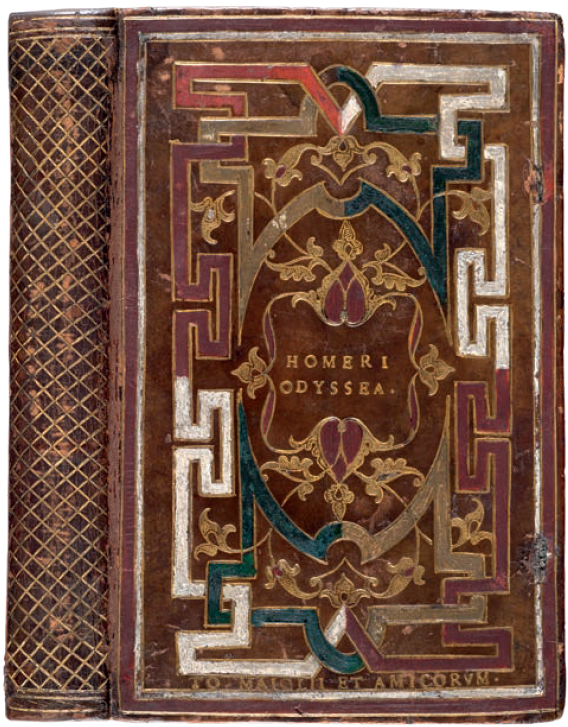
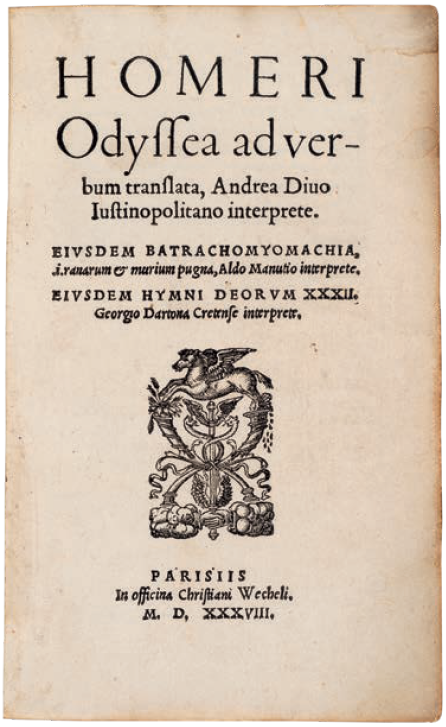
Odyssea ad verbum translata, Andrea Divo Iustino politano interprete
Omero
Christian Wechel
Paris
1538
8vo (175 x 112 x 34 mm)
Inv. 0520
Catalogue N. A464
Description
Provenance

Homer, Odyssea ad verbum translata Andrea Diuo Iustino Politano interprete, C. Wechel, Paris 1538
Like Jean Grolier, Thomas Mahieu had his name and mottos tooled on the covers of his bindings, of which, in addition to this volume, two examples are held in the Cerruti Collection (see Fig. 1 and Fig. 2). Like Grolier, he used a Latin form of his name with the addition of “et amicorum”. It is possible that Jean Mahieu, Grolier’s head clerk in Milan, was Thomas’s father. Thomas Mahieu knew Grolier in Paris, and was given at least four books by him. He was influenced by him and had his own considerable collection of books bound by some of the same Parisian ateliers that Grolier also patronised. Mahieu used two monograms, a simple “TDM” [Thomas de Mahieu or Dominus Thomas Mahieu] and a more complex one, containing the letters “AEGHIMNOPRSTV”, standing for: “Thomas Mahiev Ingratis Servire Nephas” [it is an abomination to serve the ungrateful]. His other motto, “Inimici mei mea mihi (or michi) non me mihi (or michi)” [My enemies have taken my goods from me, not my soul] is the later of the two. Both sound like those of a disappointed or even embittered man.
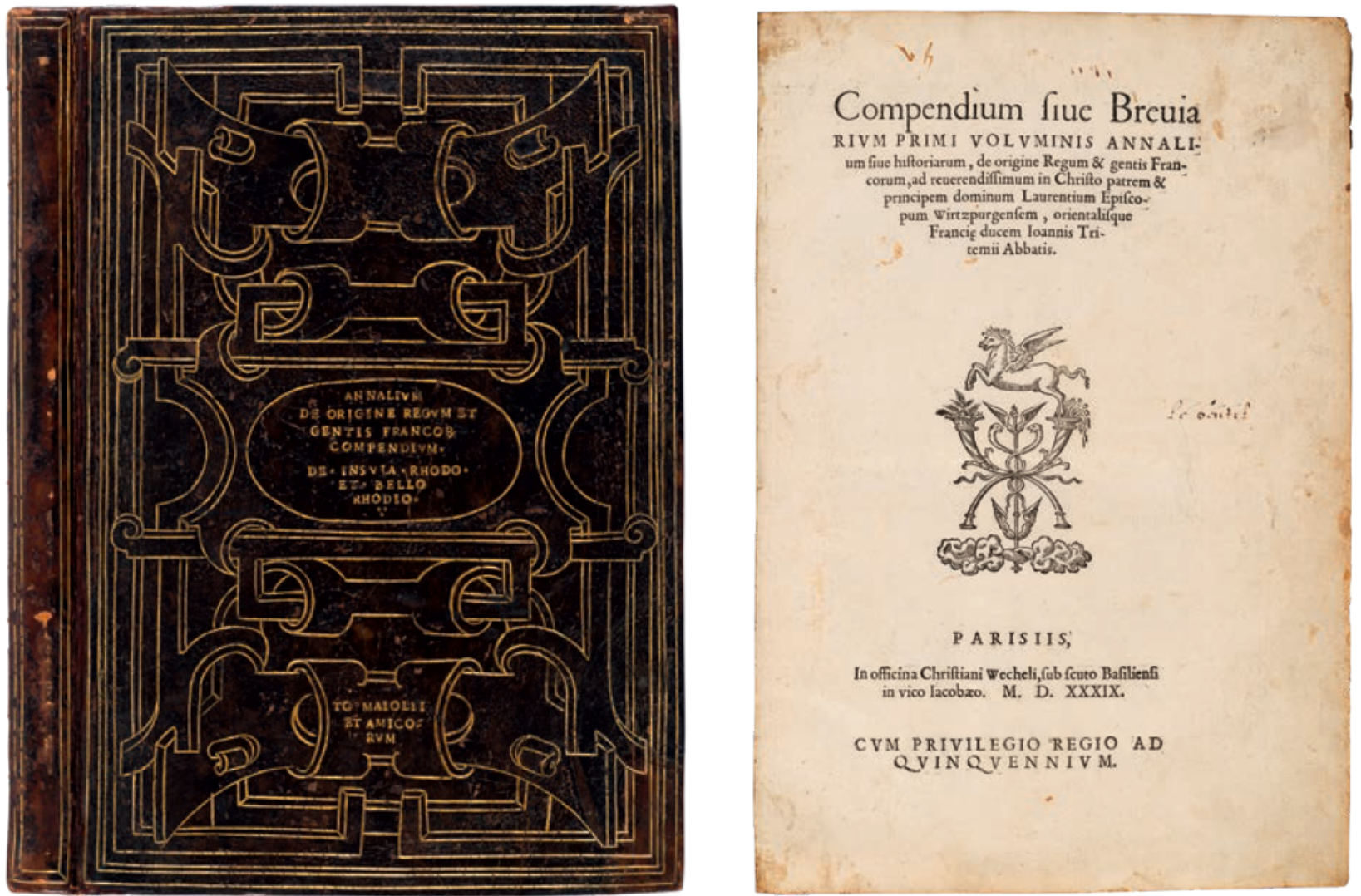
Johannes Trithemius, Compendium sive Breviarium primi voluminis
Thomas Mahieu became conseiller secretaire du roi in 1547. Two years later he was appointed premier secretaire des finances to Queen Catherine de Medici. Between 1552 and 1554 his name appears in several books as the signatory of the royal privilege. He left the Queen’s service c. 1559. In 1562 he became secretary to the future Henri III. At the same time he was appointed Tresorier de France and General des finances for Languedoil, a post which he lost in 1571-72. He was still alive in 1588.1
His library has been estimated at about 113 books, which were bound in Paris by at least four different binders.2 Two of the bindings described and illustrated here are decorated with tools that were formerly attributed to Claude de Picques.3 However, the solid tools, formerly attributed to Claude de Picques, have been shown to have belonged to Jean Picard (c. 1540-47), bookseller and binder.
Bindings with (mainly) hatched tools, formerly attributed to Claude de Picques, are now attributed to Gommar Estienne. It is possible that Picard was responsible for binding the Dionysius Halicarnassus before 1547. But, if it was bound after that date, the likelihood is that both bindings described above were the work of Gommar Estienne. The 1538 Homer was almost certainly bound by him. The third binding described here is decorated entirely with lines and gouges and has no engraved finishing tools. Mahieu owned at least thirty bindings decorated with lines and gouges only, but as styles and designs are very easily copied, attributions on the ground of style alone are too haphazard to be useful.
Mirjam Foot
1 J. Veyrin-Forrer, “Notes sur Thomas Mahieu”, in Rhodes 1994, pp. 321-349.
2 Foot 1978-2010, vol. I, pp. 183-191.
3 Nixon 1965.
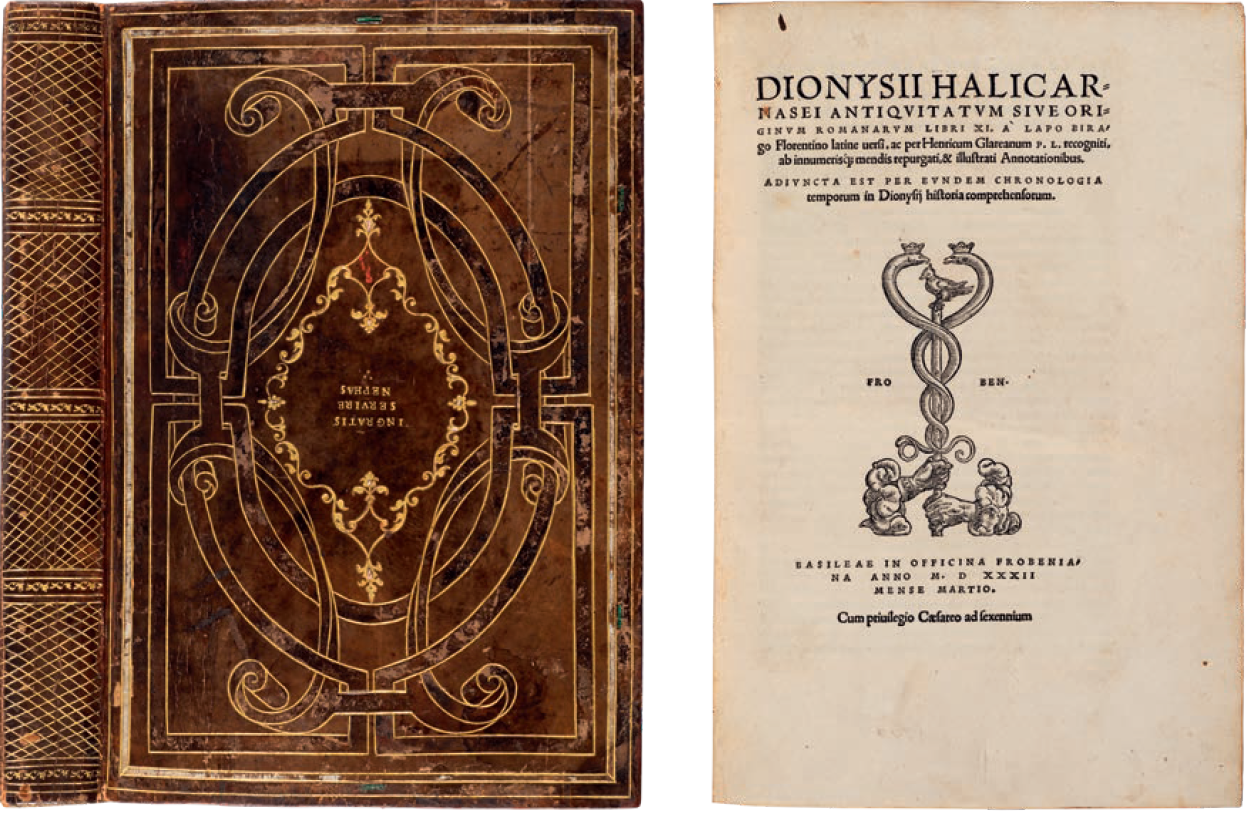
Dionysius Halicarnassus, Antiquitatum sive originum Romanarum libri XI