Book of Hours, Use of Rome
Modena
c. 1480-1485
88 x 62 mm
Inv. 0755
Catalogue N. A677
Description
Provenance
Bibliography

Book of Hours, Use of Rome, Modena c. 1480-85
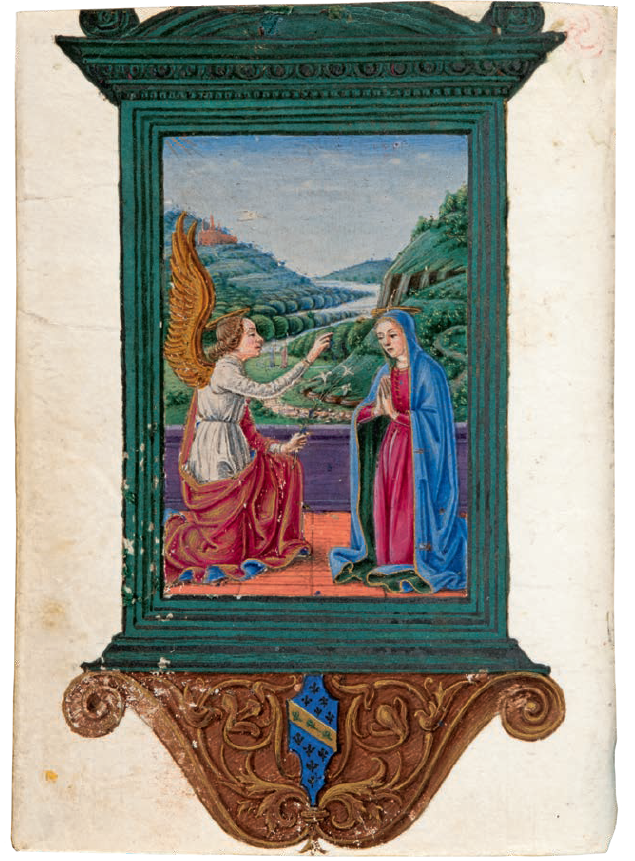
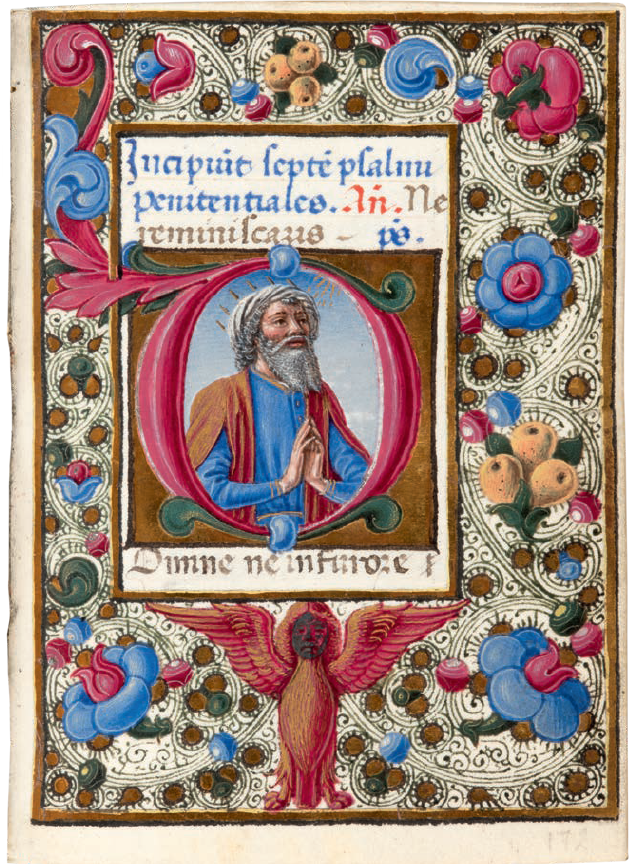
The calendar in this tiny Book of Hours is preceded on fol. 4v by a frontispiece where, inside a Renaissance-style aedicular frame, an Annunciation is depicted with a river landscape in the background. Five historiated initials accompanied by rich decorated margins are instead placed at the opening of the Hours of the Virgin (fol. 17); the Office of the Dead (fol. 115); the Seven Penitential Psalms (fol. 172); the Votive Mass of the Blessed Virgin Mary (fol. 210); and the Gradual Psalms (fol. 218). They respectively depict: the Madonna and Child; the skull of Adam; David at prayer; the Virgin and the Holy Spirit; and the Christ Child holding a goldfinch. The manuscript, sold on the antiquarian market with an attribution to Martino da Modena, immediately entered the critical debate concerning the Emilian illuminator. Indeed, it did not escape the attention of Lyle Humphrey, who emphasised the evident affinities that the Cerruti Book of Hours reveals, both in terms of its format and layout, with the two Books of Hours created by Martino in Venice in around 1471 for the Garzoni family (Venice, Museo Correr, MS. CL.V.8), and for the Erizzo and Priuli family (London, The British Library, Stowe MS. 29).1 For his part, Daniele Guarnelli saw the manuscript now in Turin as a work post-dating Martino’s move to the lagoon city, despite still owing a strong debt to the inspiration absorbed by the artist during that stay, as can also be observed in the style of another two Books of Hours from more or less the same period: one, in a private collection, attributed to the Emilian illuminator by Angela Dillon Bussi,2 and another sold firstly by Sotheby’s and then by Tenschert.3 The dating of the Cerruti Book of Hours to the 1480s has recently been supported also by Federica Toniolo.4
The historical context in which the manuscript now in Turin was produced can be clarified by more detailed research into the recipients of the volume, whose coats of arms (probably original) can still be seen on fols. 4v and 17.5
Giovanna Saroni
1 Levi D’Ancona 1966, pp. 28-29; Mariani Canova 1969, pp. 78-79, 158 cats. 94 and 95; F. Toniolo, “Codici emiliani del Rinascimento in Veneto”, in Marinelli, Mazza 1999, p. 54. The British Library Book of Hours has been digitalised: https://www.bl.uk/catalogues/illuminatedmanuscripts/ record.asp?MSID=1294&CollID=21&NStart=29. For the bibliography on Martino da Modena (1430/40 - c. 1490), refer to: Lollini 2004, pp. 739-740.
2 A. Dillon Bussi, “Nuove proposte per Martino da Modena”, in Mariani Canova, Perriccioli Saggese 2014, pp. 566-568. The codex, which was exhibited in the Esposizione italiana di Arte sacra held in Turin in 1898, bears the coat of arms of the Campana family from Ferrara.
3 Fifty Magnificent 2002, pp. 178-179, lot 33; König 2011, pp. 180-187, lot 14.
4 F. Toniolo, cat. 19, in Carvalho Dias 2020, pp. 186-193.
5 On fol. 4v, on the opening page with the Annunciation inside an aedicular frame, there is a blue shield, dotted with silver lilies (now oxidised), with a cross band of gold, bearing three green […] leaves. In the bottom margin of fol. 17, which corresponds to the incipit of the Hours of the Virgin, the shield is divided, with a gold background on the bottom left, above a rocky mountain with three peaks out of which a waterfall (?) flows that is silver at the tip, with a gnarled green tree atop the central peak; the top left is silver and features a red rose above a strip in the same colour; the right-hand side is blue, divided by a gold band with three stars. There are no evident signs of superimposition or erasures in correspondence to the two coats of arms. The Günther sale entry proposed attributing the first part of the shield on fol. 17 to the jurist Bartolomeo Codegori of Ferrara and the second to the Ginori family of Florence; and the coat of arms on fol. 4v to the Tolomei- Gucci family of Florence. Luisa Gentile, whom I wish to thank, points out to me that the attribution to Codegori, unlike the others that are uncertain, is certainly incorrect (see Ferrara d’oro 1674, p. 145, where the jurist’s coat of arms is described with decidedly different colours and figures).