Bookstand
Palermo area
Palermo
First quarter of the 18th century
Engraved ebonised wood, tortoiseshell, engraved tortoiseshell, engraved sheet silver, sheet silver, brass, paper
40 x 32 x 11 cm
Acquisition year 2008
Inv. 0613
Catalogue N. A543
Provenance
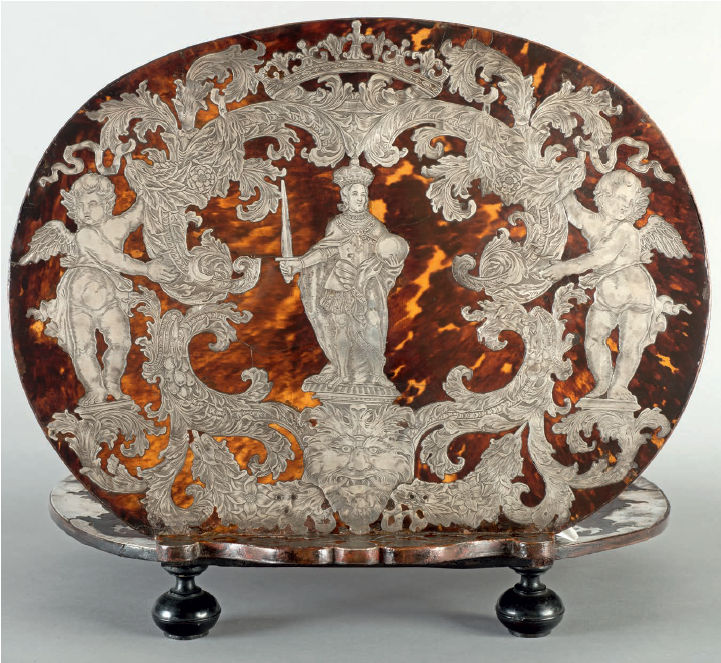
This bookstand, with its angled folding brass reading surface, features characteristic counterpart decoration, or rather the same image in positive and negative on the surfaces of the two main elements. The front is covered in tortoiseshell with illustrations engraved on sheet silver, while the back (fig. 1), visible when the bookstand is open, has a sheet silver background and engraved tortoiseshell figures. This counterpart inlay technique made it possible to use all the precious materials completely, with no waste, producing particularly decorative outcomes.
The back of each panel is in painted ebonised wood, as are the borders around the edge, while the base, which is fitted with four round feet, is decorated with paper appliques painted with foliage and varnished over the top (fig. 2). In the palest sections of the engraved tortoiseshell parts we can see the underlying preparation consisting of a golden bottom layer, in keeping with the most sophisticated cabinetmaking tradition. Generally speaking, the inclusion of a bottom layer, in gold leaf, gilded sheet metal or even paper coloured with golden yellow pigments, is designed to add a beautiful touch of iridescence and a warm hue to the surface. The inlaid parts in sheet silver feature burin engravings with highly technical and detailed images. The engravings on the tortoiseshell only differ in a few details, such as the rendering of the ermine cloak, recreated purely through shading, but always with a very fine technique.
The bookstand has undergone various restorations, visible in the additions of the sheet silver parts in the shaped support upright and depicting a winged figure in the centre whose head, evidently lost, has been replaced with an unengraved sheet. The missing tortoiseshell sections have, instead, been filled with stucco, probably using pigmented wax. Widespread abrasions and deposits of materials used to polish the silver are present in the grooves of the tortoiseshell engraving.
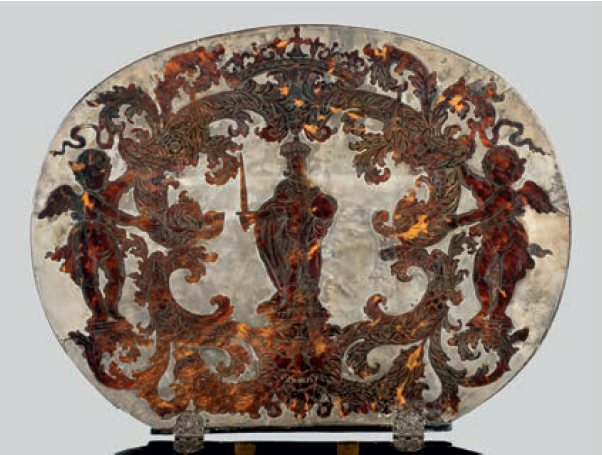
Fig. 1. Back surface.
The frame decoration held up by an angel on either side makes clear reference to 17th-century Sicilian silverware, whose figurative paradigm is the box urn containing the relics of St Rosalia in the cathedral of Santa Maria Assunta in Palermo, produced in the 1630s. In the centre of the bookstand we can see a sovereign in the guise of an emperor who cannot be identified with any degree of certainty, but is perhaps an ideal celebration recalling the imperial role of Frederick II of Swabia, but closer in style to the statue of Philip IV of Habsburg erected in 1662 in front of the Royal Palace in Palermo and destroyed in 1848. Printed images of this statue circulated widely during the 18th century and can be identified as the probable model for the central image on the bookstand.
The work entered the Cerruti Collection in 2008 when it was purchased on the Genoese antiques market. This extraordinary object was chosen due to Cerruti’s love of fine 18th-century European cabinetmaking and fits perfectly into his collection of works, mainly from Piedmont and France, comprised solely of exceptional examples.
Stefania De Blasi
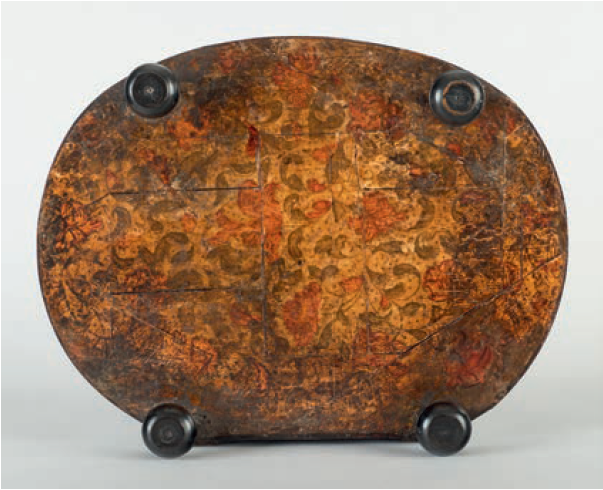
Fig. 2. Base.