
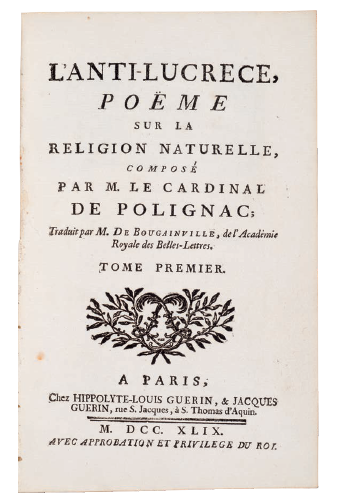
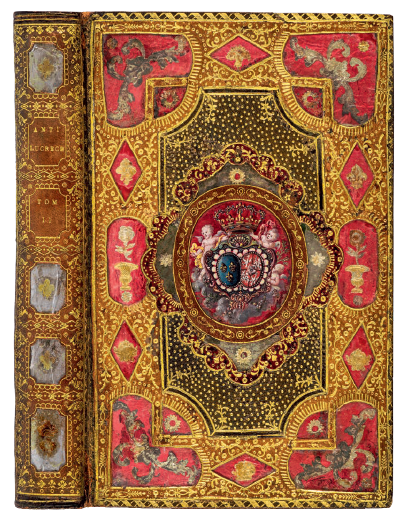
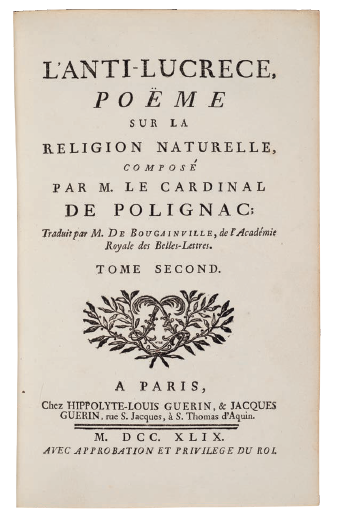
L'Anti-Lucrèce, poëme sur la religion naturelle
Melchior de Polignac
Hippolyte-Louis Guerin & Jacques Guerin
Paris
1749
2 voll., in 8vo (vol. I: 218 x 140 x 39 mm; vol. II: 220 x 140 x 35 mm)
Inv. 0500
Catalogue N. A444
Description

Cardinale Melchior de Polignac, L’Anti-Lucrèce. Poëme sur la réligion naturelle, traduit par M. de Bougainville, H.-L. Guerin e J. Guerin, Paris 1749, 2 vols.
These two mosaic bindings were made in Paris for Maria Leczinska. Maria Leczinska (or Leszczynska, 1703-68) was the second daughter of Stanislas I Leczinski (1677-1766), sometime King of Poland (1704-09 and from 1733-36, when he abdicated, becoming Duc of Lorraine and Bar in 1737).
Her mother was Catherine Opalinska. She was born in Breslau on 23 June 1703. When her father was dethroned in 1709, he and his family fled, first to Sweden. They then lived in Germany, before settling in France, in Alsace (1719). On 5 September 1725 Maria married Louis XV, King of France, who was seven years her junior. Louis took several mistresses, among whom Madame de Pompadour and Madame du Barry are perhaps the best known. Maria, religious by upbringing, became more pious and devout.
She loved music and played several instruments, moderately well; she also painted religious pictures and had a small printing press in her apartments. She had ten children but only four daughters survived her. She died on 24 June 1768.1 She accumulated a library, mainly of religious and history books, which were bound in Paris in elaborately gold-tooled mosaic bindings according to the fashion of the day. A similar binding for Maria Leczinska is illustrated in L. M. Michon, Les reliures mosaïquées du XVIIIe siècle (Paris, 1956), no. 56, pl. VI, attributed to Derome. A similar binding for her father is attributed to Nicolas-Denis Derome le jeune.2 One of the fleurons used on the binding illustrated here occurs on the binding of a copy of Longus, 1757, with a pasted-in trade card of P.-P. Dubuisson, but with an alternative attribution to J.-A. Derome.3 Nicolas- Denis worked with his father, J.-A. Derome, and took over from him c. 1760. French 18th-century mosaic bindings are all decorated with very small tools of very similar designs, which makes attribution problematic, unless the bindings are signed.
Mirjam Foot
1 For contemporary biographies and for her religious practices see G. Barber, “‘Il fallu même réveiller les Suisses’: Aspects of Private Religious Practices in a Public Setting in 18th-century Versailles”, in Aston 1997, pp.75-101. See also Quentin-Bauchart 1886, vol. II, pp 37-54.
2 Foot 1978-2010, vol. III, no. 182, with at least one tool identical to one found on the binding of vol. I for Maria Leczinska, illustrated here. For the Derome family, see cat. p. 292 and Foot 1978-2010, vol. I, pp. 199-201.
3 Barber 2013, vol. II, cat. 423.