
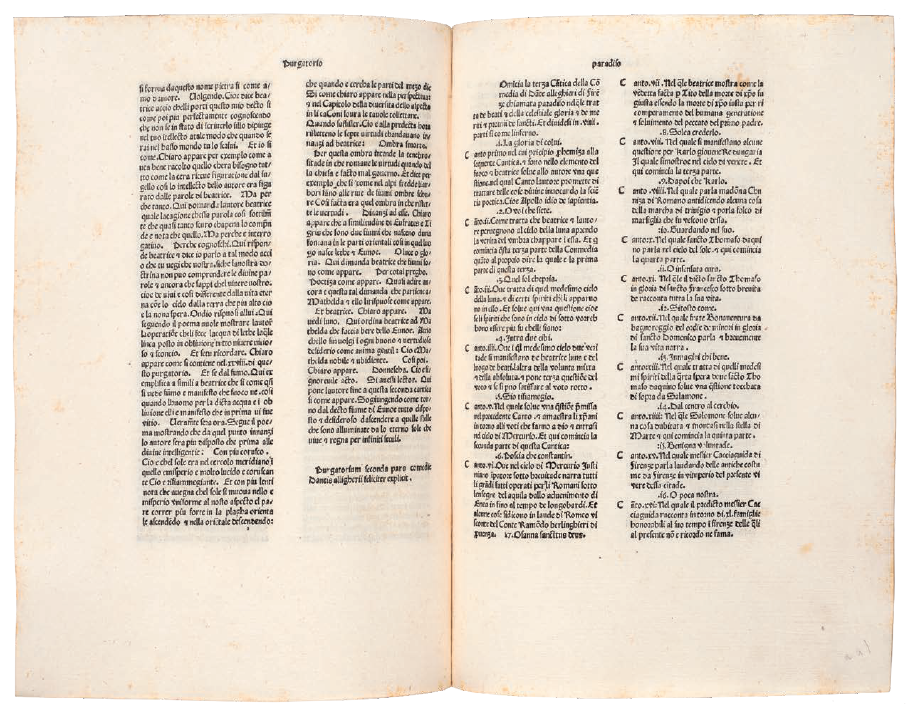
La Commedia
Dante Alighieri
Vindelinus de Spira
[Venice]
1477
in-folio (376 x 283 x 107 mm)
Inv. 0744
Catalogue N. A669
Description

Dante Alighieri, La Commedia, Vindelinus de Spira, [Venice] 1477
First commented edition and fifth edition overall of the Divine Comedy, published by Cristoforo Berardi of Pesaro. The erudite commentary was written between 1323 and 1328, just a few years after Dante Alighieri’s death (1321). The first integral commentary on this masterpiece, it has been unanimously attributed to Jacopo della Lana (c. 1278 - c. 1358), and not to Benvenuto da Imola or Benvenuto Rambaldi (1330-88), as stated in the prefatory sonnet. In this text, Jacopo della Lana shows himself to be a man of great culture, examining doctrinal and philosophical issues systematically, going beyond the analysis of grammatical and literary aspects. Much praised from the start for its clear interpretation and use of the vernacular, the text enjoyed such widespread success that it was reproduced in approximately 100 codices, at the time. As well as being the first commented printed edition of the poem, the edition by Windelin von Speyer, or Vindelinus de Spira, also includes, for the first time, Boccaccio’s Life of Dante, one of the most important biographical sources on Dante. In fact, Giovanni Boccaccio (1313-75) was one of the first great defenders of Dante, whom he praised in sundry texts.
In 1373, the city of Florence asked Boccaccio to give a series of lectures in an attempt to redress the embarrassment of having condemned its most famous citizen to exile. The text in question is thus the first edition of the Commedia produced with openly historical and educational intents. The volume also contains the Capitolo, also in tercets, by Jacopo Alighieri, son of the great poet. This famous edition by Windelin von Speyer, a much-praised German printer active in Venice, came a few years after Petrarch’s Canzoniere, published in 1470 by the same publisher, highlighting his resolution to hold vernacular authors in the same high esteem as the great Latin classics. At the time, Dante’s masterpiece was simply known as the “Comedy”, and it was only with the Gabriele Giolito de’ Ferrari edition of 1555 that it took the title of “Divine Comedy”. However, it is interesting to note that, in the sonnet which closes Windelin’s edition, the adjective “divine” is attributed to Dante and not to the work, so that he is referred to as the “illustrious and divine Dante”. The use of the Gothic font is also interesting, as it sought to reproduce the layout of religious texts of the time.
Roberto Cena