
Il risveglio della bionda sirena (Il risveglio della sirena bionda)
Reawakening of the Blonde Siren
Scipione (Gino Bonichi)
1929
Oil on panel
80,5 x 100,2 cm
Acquisition year 2000
Inv. 0171
Catalogue N. A164
Provenance
Exhibitions
Bibliography
Referred to as “…this orgiastic and refined work, albeit of an inebriated popular exaltation and pertaining more to a fair than the theatre”,6 the work went on to become the emblem of the “reawakening” of the new tonal painting of the 1930s and 1940s
When Gino Bonichi, an artist from the Marche, submitted Il risveglio della bionda sirena (Reawakening of the Blonde Siren) to the Mostra Sindacale Romana in 1930, he was just twenty-six years old and had only made a timid debut on the art scene, so much so that his pseudonym Scipione was still written in inverted commas in the catalogue. Room VI in the Palazzo delle Esposizioni also featured art by Mario Mafai, whom Scipione had got to know in in 1924, with this acquaintance helping him establish himself on Rome’s post-war art scene. His close friendship with Mafai and later with Antonietta Raphaël, within his intense Bohemian lifestyle described by later biographers, placed him within the “Via Cavour school” as Longhi had christened the three “expressionists”, exponents of “an eccentric and anarchical painting style that would struggle to take root among us.”1 Effectively speaking, there was great controversy surrounding young Roman painting in 1930, from the archaism of Francesco di Cocco to the purism of Riccardo Francalancia. Scipione responded to this by being exceptionally open to contemporary painting from northern Europe, making an unprecedented comparison with antique and Baroque art, which he studied in Rome’s museums and in the art library at Palazzo Venezia. This painting, produced in Rome in autumn 1929 during a period of renewed production following a happy summer holiday in Ciociaria, was the largest ever to have been exhibited by Scipione up to that point, second only to the renounced 20th-century-style Leda of the previous year.2 An initial version was set down in a drawing (fig. 1), probably given to Raphaël in tribute to her inspiration for the unusual subject. As has been observed by Maurizio Faglio dell’Arco, four years earlier the female painter had written a long letter to Mafai in which she described a dream with a siren singing by moonlight in the waters of the “lake in Perugia” and combing her hair, “tidying her beautiful golden curls”.3 This fleeting fabula is lost in the mysterious attributes that surround the siren and that, for Oppo, justify the decision to class this work among the artist’s still lifes to all intents and purposes.4 Objects and animals differ in part from the drawing and allude generically to the erotic symbols of tarot cards, as in Asso di spade (Ace of Swords) exhibited on the same occasion. Reviews, including one by his friend De Libero who reproduced the painting for the first time, ascribe its motif to the Surrealist environment,5 alluding to references to Chagall as regards the spatial incoherence of the scene and to Picasso for the rereading of Pompeiian painting. Purchased promptly by the editor of the Tribuna Illustrata, Giuseppe De Blasio, Il risveglio della bionda sirena was exhibited in the artist’s final retrospective at the second Quadriennale di Roma in 1935 following his early death. Referred to as “…this orgiastic and refined work, albeit of an inebriated popular exaltation and pertaining more to a fair than the theatre”,6 the work went on to become the emblem of the “reawakening” of the new tonal painting of the 1930s and 1940s, at the exact time that “Scipione’s life was about to become legendary”,7 as Giuseppe Marchiori wrote in his first monograph of 1939. When it appeared in the Milanese collection of Princess Ruspoli Blanc in 1957, its position as a “textbook piece” within the canons of modern Italian painting was guaranteed. When the painting changed hands and entered the collection of the critic and art historian Luigi Carluccio in 1963, it introduced Scipione to Turin under the sign of the critical and collecting success of Surrealism. The young Francesco Federico Cerruti may have seen the work for the first time in the critic’s collection and in the exhibitions of the 1960s. In any case, over the following decades the Blonde Siren became the symbol of Turin’s interest in Scipione, both on the market and in historiography. Upon Carluccio’s death, the work was purchased by Giovanni Audoli, an electrical industrialist and collector, who was “enchanted”8 by it and by Scipione (also collecting the aforementioned Ace of Swords). This marked the start of the most important collection of the 1980s dedicated to the Roman School, contributing to Fagiolo dell’Arco’s momentous exhibitions. Cerruti only acquired the work from Audoli on 18 July 2000, thanks to a swap (not an advantageous one in financial terms) for a Natura morta con sei elementi (Still Life with Six Elements, 1942) by Giorgio Morandi and a Paesaggio (Landscape, 1960) by Nicola Galante.
Filippo Bosco
1 R. Longhi, “La Mostra romana degli artisti sindacati”, in L’Italia Letteraria, 14 April 1929, in Fagiolo dell’Arco, Rivosecchi 1988, p. 81.
2 “I sold that botched Leda for 1,000 (I say One Thousand) Lire” (letter from Scipione to R. Mazzacurati, July 1929, in Fagiolo dell’Arco, Rivosecchi 1988, p. 300).
3 Letter from A. Raphaël Mafai to M. Mafai, 11 August 1925, in Fagiolo dell’Arco 1986, p. 74.
4 See Rome 1935, p. 77. See also Mafai’s lovely recollection: “He exhibited some very interesting pieces at the Sindacale in 1930, a whole world of objects painted with a thick, loaded material. It was as if Scipione had injected a vitality into the objects: he had given them their own space, their own colour, their own graphics; they were no longer just a bottle and just a pear in the usual scheme of things” (Mafa 1933).
5 “…the pairing of the flora and fauna is resolved in an unconscious and saturated spectacle: there the flowers and fruits break open in feverish sexes, and the hot moon acts as a pivot for the vision: the blonde siren after a submarine fair prepares her hair for a journey to the unfound islands” (De Libero 1930).
6 Callari 1935, p. 153.
7 Marchiori 1939, p. 6.
8 See an interview with Audoli in 1988: “It was a painting that changed the history of my life. A masterpiece […] it is the reawakening of the blonde siren, painted by Scipione in 1929, which years ago convinced me to stop collecting Sironi and de Chirico in order to set out on a quest for the ‘great obscure names’ of our 1930s, such as Ferruccio Ferrazzi and Alberto Ziveri […] Experiencing them day by day […] I realised that these paintings outclassed all my others for a series of reasons. For example, with the quality being equal, they were fresher and more packed with truth to my eyes […] I transformed some works by de Chirico and Savinio to have these less well-known artists. I don’t share this obsessive formula of many collectors who accumulate relentlessly; I prefer rotation and study, the evolution (or involution!) of a collection…; I am not interested in the financial value of paintings but in their historic value. I am gratified by the idea of possessing some masterpieces of the Roman School because I know that they are in any case museum pieces, that any museum in the world would like to have” (Vallese 1988, pp. 36-39).
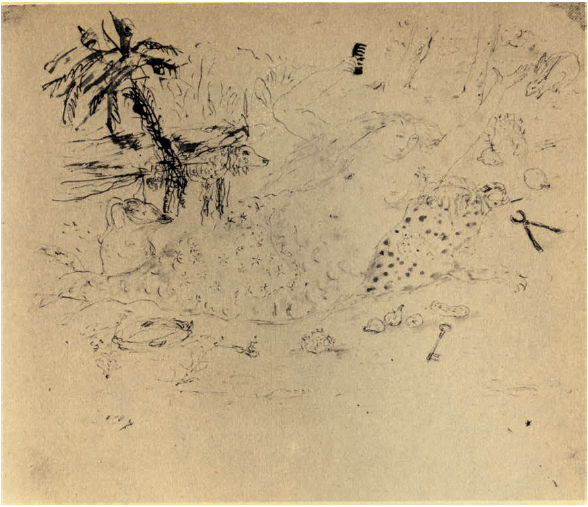
Fig. 1. Scipione, Il risveglio della bionda sirena (Reawakening of the Blonde Siren), 1929, ink on paper. Private collection.