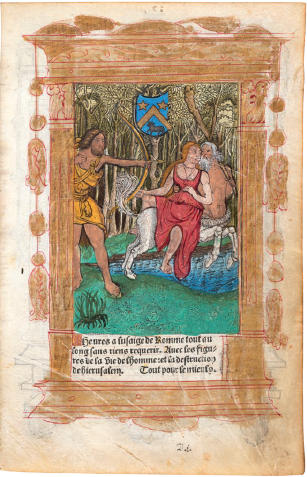
Heures à lusaige de Romme tout au long sans riens requerir. Avec les figures de la vie de l'homme et la destruction de Hierusalem
Gilles Hardouyn
Paris
1512
8vo (227 x 154 mm)
Inv. 0503
Catalogue N. A447
Description
Provenance
Bibliography
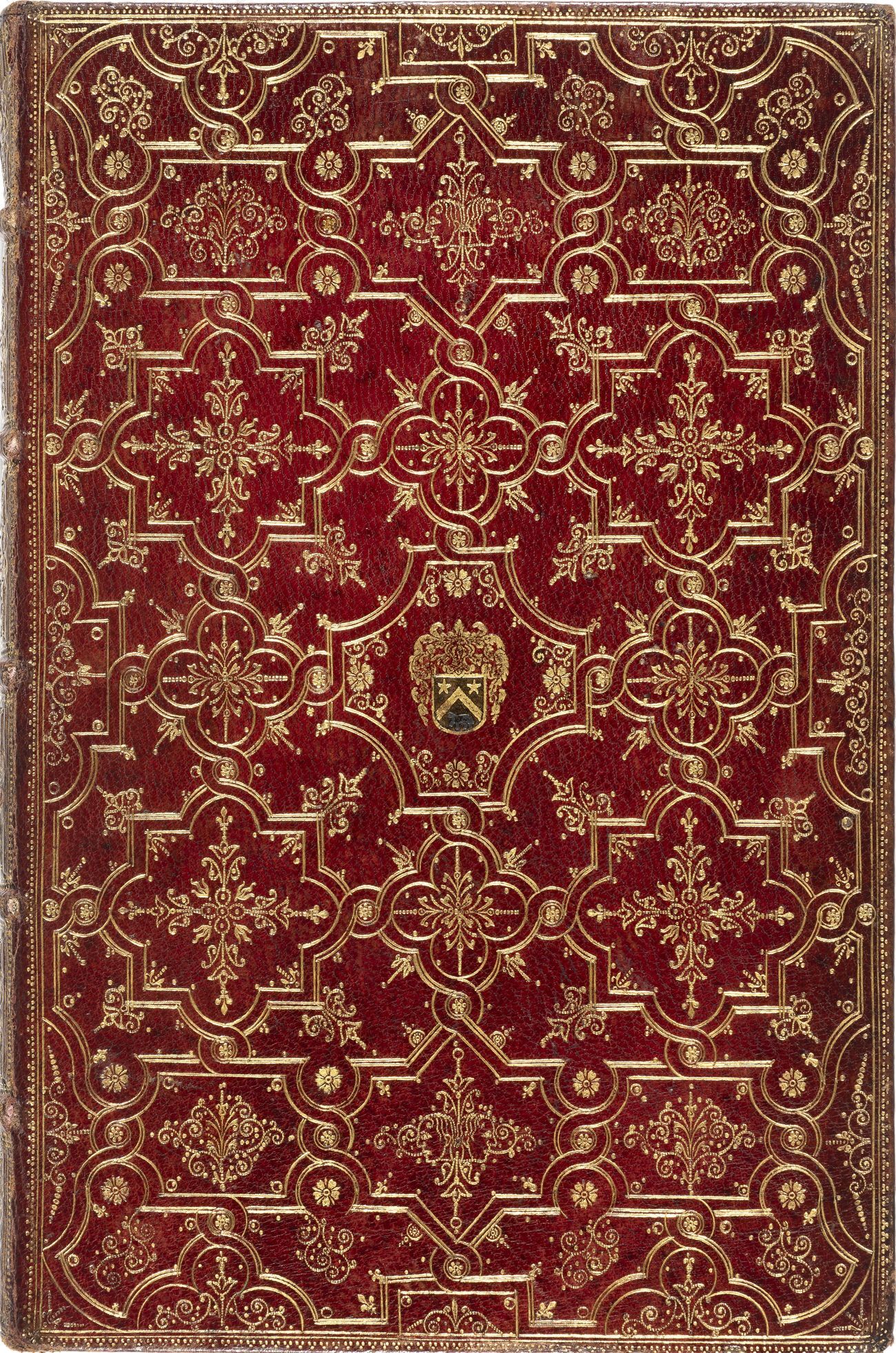
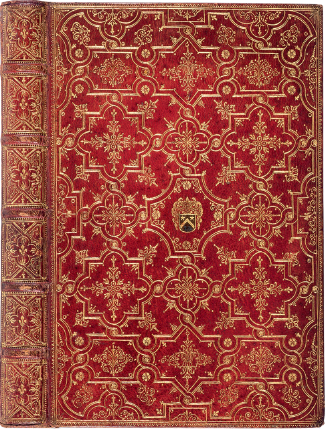
Heures à lusaige de Romme tout au long sans riens requerir. Avec les figures de la vie de lhomme et la destruction de Hierusalem, Gilles Hardouyn, Paris, [1512]
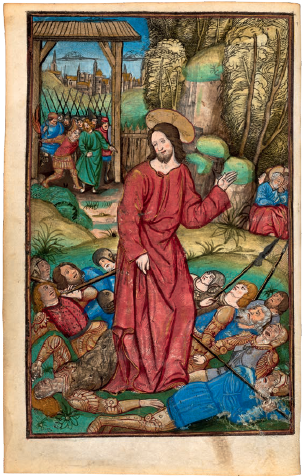
This luxurious book, written in Latin and French and embellished with full-page illustrations and woodcut margins, was printed around 1512 by the publisher Gilles Hardouyn, who, together with his brother Germain, produced hundreds of Books of Hours in the first decades of the 16th century. These books were often hand-finished in tempera and gold and were intended for the Parisian market or for export.1 The Cerruti Book of Hours features a very rich iconography: the text pages are enclosed by woodcut frames with figurative scenes and decorative motifs; twenty full-page coloured and gilded woodcuts open and close the book and accompany the principal sections of the liturgical text, such as the rare scene of the Ego sum (John 18:5) at the start of the Passion of Our Lord according to John (fol. 8v). Lastly, twenty-seven small historiated panels, once again featuring woodcuts and illumination, accompany the selected passages from the Gospels and the Litanies. In the 17th century, the Hardouyn publishing mark - present on the title page and in the colophon of the book (fols. 1-90v) - had the coat of arms of Pierre Séguier placed over it, accompanied by his monogram and by that of his wife Madeleine Fabri.2 At the same time, probably not long after Pierre Séguier was made chancellor to Louis XIII, King of France (1635), the Book of Hours was given a splendid new binding in the workshop of Pierre Rocolet (cat. p. 240). At an unspecified date, the volume passed to England in the hands of the merchant and antiques dealer George Weare Braikenridge (1775-1856), and was displayed in the Art Treasures Exhibition in Manchester in 1857. It subsequently travelled to the United States, where it formed part of the important book collections firstly of Cortlandt Field Bishop (1870-1935) and then of Lucius Wilmerding (1880-1949).
Giovanna Saroni
1 Renouard [1898] 1965, pp. 197-198.
2 Regarding Pierre Séguier, see the pages by Mirjam Foot in the catalogue (cat. p. 240) and Nexon 2015.