
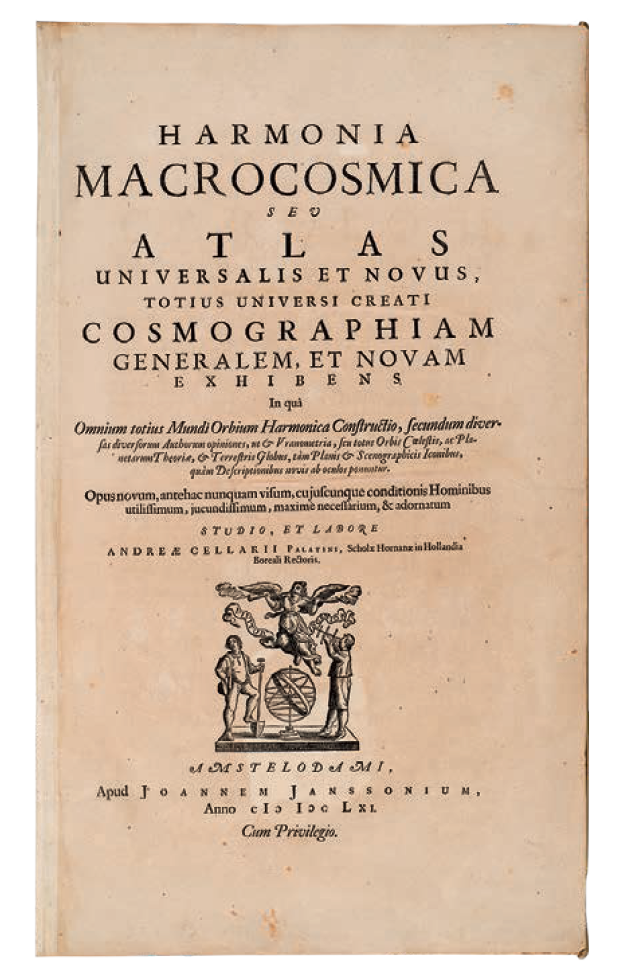
Harmonia macrocosmica seu atlas universalis et novus, totius universi creati cosmographiam generalem, et novam exhibens
Andreas Cellarius
J. Jansson
Amsterdam
1661
in-folio (530 x 357 x 69 mm)
Inv. 0713
Catalogue N. A637
Description
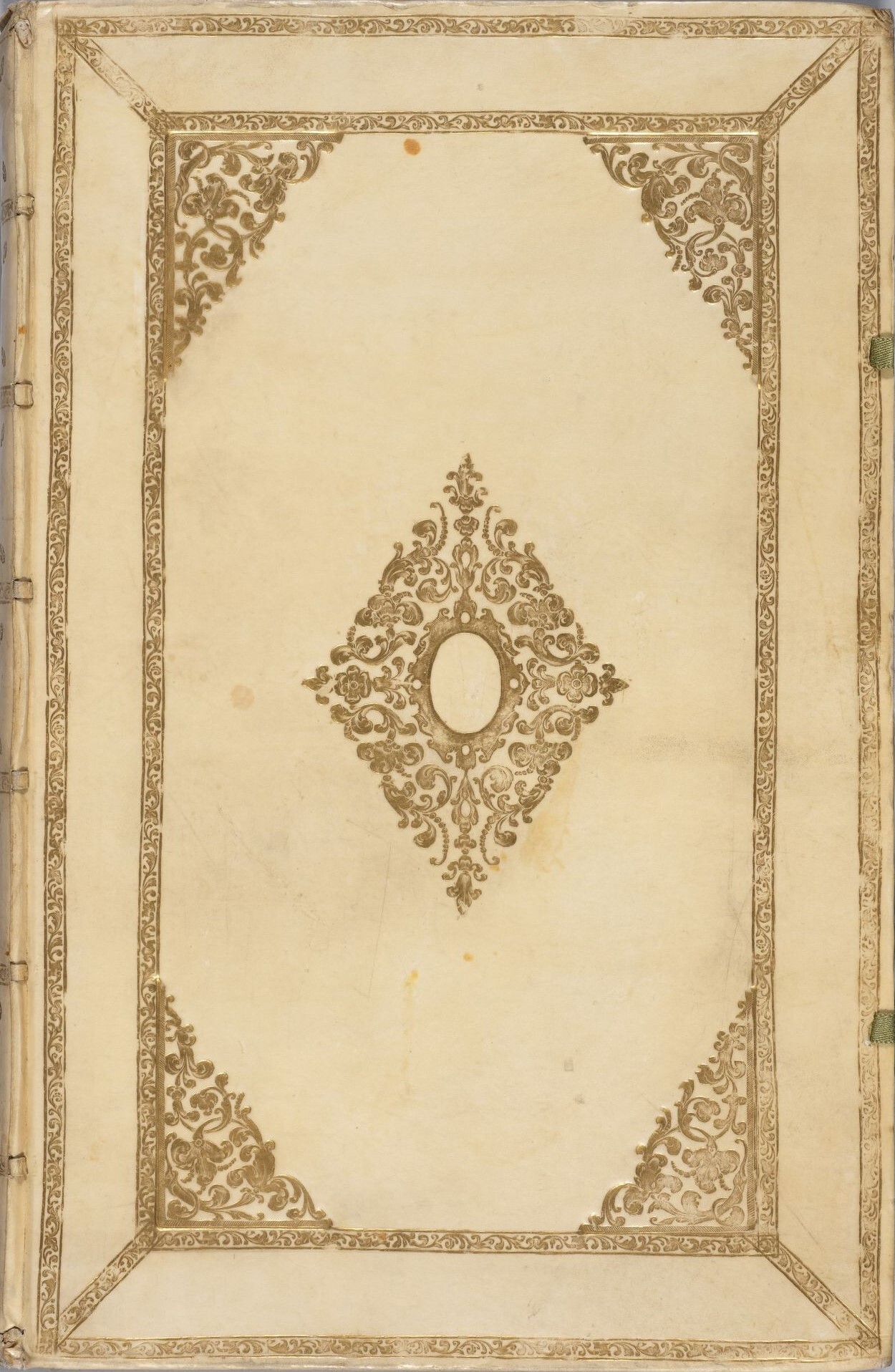
Andreas Cellarius, Harmonia macrocosmica seu atlas universalis et novus, totius universi creati cosmographiam generalem, et novam exhibens, J. Jansson, Amsterdam, 1661
This sumptuous volume by the German cartographer Andreas Cellarius (c. 1596-1665) is considered the most spectacular astronomical work of the 17th century. It was the only celestial atlas published in Holland at the height of the so-called “golden age” of Dutch cartography. The work aimed to highlight the cosmological harmony of the universe, and the maps represent the apex of 17th-century astronomical thinking.
There are twenty-nine plates in total. The first twenty-one represent the three competing astronomical systems of the time. The system associated with Claudius Ptolemy of Alexandria (100- 178 AD), which is the oldest, was in use until the early 16th century. It was based on a geocentric system, in which the Sun, the planets and the shell of the fixed stars were arranged in concentric spheres and revolved around the fixed planet Earth. The theory was approved by the Church as it reinforced the Christian concept of humankind at the centre of the divinely created universe. The second system was that of Nicholas Copernicus (1473- 1543), whose observations led to the publication of De Revolutionibus Orbium Coelestium (On the Revolutions of the Heavenly Spheres) in Nuremberg in 1543. Copernicus places the Sun at the centre, with the planets revolving around it in circular motion. It took a century and a half to verify his theories, when a new type of physics managed to establish itself, albeit at great cost for scientists such as Galileo Galilei. The third system was that of Tycho Brahe (1546-1601), who attempted a mediation between the old Ptolemaic concepts and certain aspects of Copernicus’s ideas. He placed the Earth back to the centre of the universe, according to the Aristotelian view, with the Moon and Sun revolving around it, the shell of the fixed stars centred around our planet, and Mercury, Venus, Mars, Jove and Saturn revolving around the Sun. Brahe’s system became popular in the early 17th century, not so much for scientific reasons, but because it sought to rectify the rejection of Ptolemaic theories now deemed obsolete, particularly by navigators such as Christopher Columbus and Vasco de Gama. It was also acceptable to those who, for reasons of faith, could not accept the Copernican alternative. The final eight plates of the volume show celestial hemispheres and planispheres depicting the constellations. Their degree of ornamentation is surprising and these maps are what make the work particularly renowned. The style of the maps was inspired by the globes of Petrus Plancius and Willem Blaeu. For instance, the custom of representing some figures in the northern constellations dressed in winter clothes derives from Blaeu’s first globes. Cellarius also includes two planispheres copied from the atlas of Julius Schiller, which show the new Christian constellations. Sundry engravers and artists worked on the plates of the atlas, but only two of them signed their work: Frederik Hendrik van den Hove, author of the title page, and Johannes van Loon, who engraved ten plates. The designs of all the classical constellations were also copied from those created by Jan Pieterszoon Saenredam.
Roberto Cena