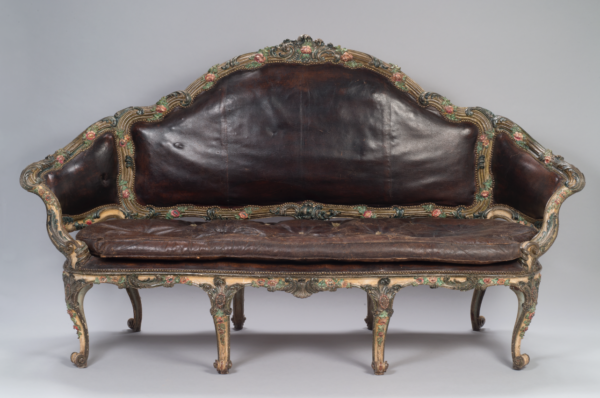
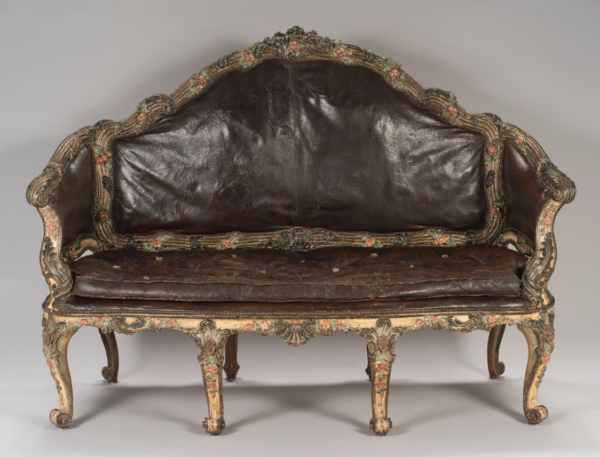
Sofa with Carved and Painted Polychromatic Decoration
Mid-18th century
Carved and painted wood, partly original leather upholstery
123 x 208 x 70 cm
Inv. 0243
Catalogue N. A233a-b
Description
Provenance
Bibliography
The two items present a complex interplay of movement and are embellished by original decoration of polychromatic carving in the Rococo style. The entire frame of the back and arms is covered by ribbing to which small garlands of brightly coloured flowers and leaves of a subdued brown cling. In the larger sofa, a splendid tangle of twisted leaves joins the arms to the seat border, where the shell motif is developed in a series of variations joined by sprigs of blossom that also continue down the supports. The latter end in a vigorous curl after an undulating movement that reverses the movement of the arms.
Over half a century later, the structural harmony, the quality of the carving and the vivacity of the colours (despite the probable alteration of the original balance through repainting) still fully justify the admiration of Vittorio Viale,1 who included the pieces in the Mostra del Barocco Piemontese exhibition of 1937 in Palazzo Carignano.2 A quarter of a century later, in the 1963 Mostra del Barocco Piemontese, he presented an identical pair now in the Museo Accorsi-Ometto, Turin, observing that there were four sofas, one of which of a different size (“quattro, uno di diversa misura”). In fact, as demonstrated by Luca Mana,3 the set comprises six items: the pair in the Museo Accorsi-Ometto, the ones addressed here and another two in Villa Abegg, formerly the Vigna of Madama Christine of France, more recently owned by the Swiss industrialist and collector Werner Abegg. The set was the property of the Arborio Mella family, originally from Biella, members of which played a leading part in the public and cultural life of Piedmont in the 18th and 19th centuries. Carlo Emanuele Arborio Mella (1783-1850) and his son Edoardo (1808-84) were among the initiators of the “historical” restoration of Italy’s architectural monuments.4
Roberto Antonetto
1 Viale 1963, vol. III, pls. 118-119.
2 See the article in Bernardi 1937c, pp. 3-15. There was no catalogue for this exhibition.
3 L. Mana, “I mobili piemontesi del Museo Accorsi-Ometto di Torino. Frammenti di storie dimenticate”, in Ghisotti, Goria 2018, pp. 152-157. The measurements of the two sofas in the museum are as follows: inv. no. 3248: 207 x 122 x 70 cm; inv. no. 3249: 236 x 125 x 70 cm. One of them was published in Antonetto 1985, p. 233, pl. 331.
4 Vercelli 2005.