De re militari
Robertus Valturius
Johannes Nicolai de Verona
[Verona]
1472
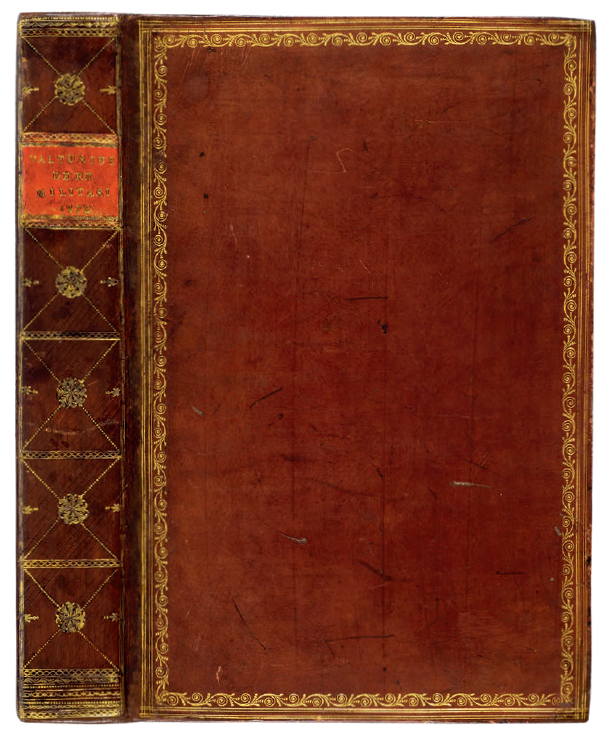
in-folio (400 x 280 x 77 mm)
Inv. 0743
Catalogue N. A668
Description
Editio princeps of this Italian typographical masterpiece - the first illustrated book of a technical nature. Based on both ancient and contemporary sources, the work was written by Robertus Valturius (1405-75) in Rimini between 1446 and 1447, in celebration of Sigismondo Pandolfo Malatesta, here portrayed as a military leader on a par with the great commanders of antiquity. After completing the work, Valturius devoted himself to promoting its circulation, as he even supervised the production of several handwritten copies (of which twentytwo are still extant today) for his patron. Sigismondo Malatesta greatly appreciated the work, so much so that he decided to send presentation copies to various rulers, including Louis XI, Francesco Sforza and Lorenzo de’ Medici.
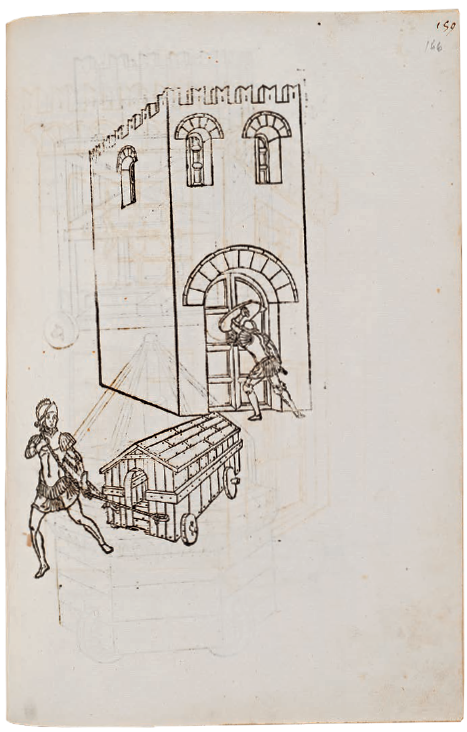
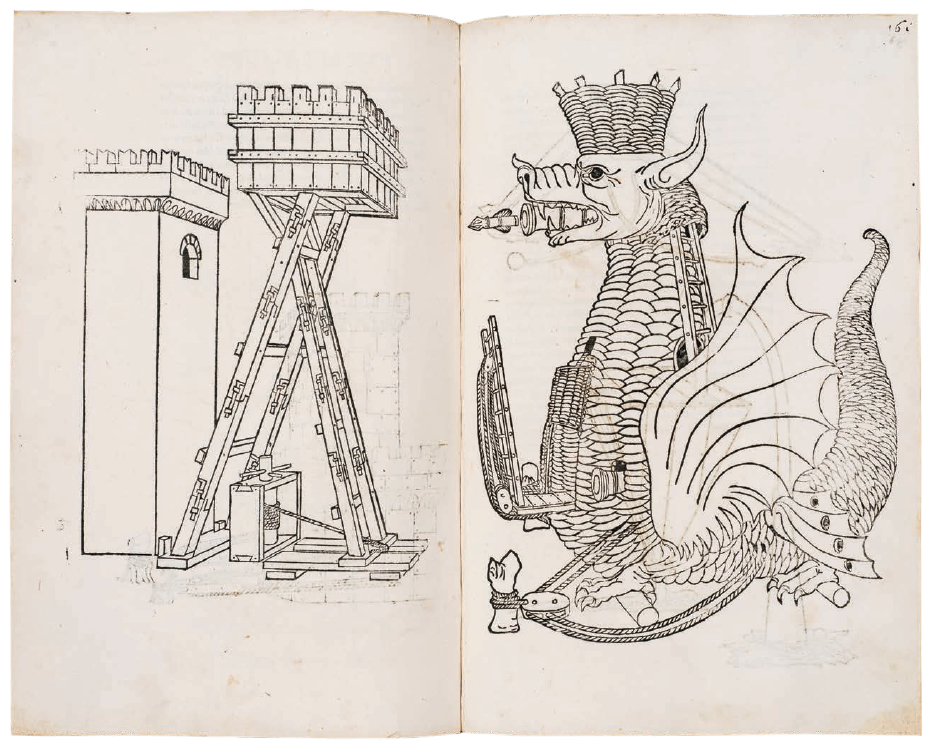
The work is a learned compilation of topics that had already been covered for the most part; but it also introduces important formal innovations. For instance, it makes ample use of technical military terms, and discusses new topics such as the use of gunpowder in war machines, which are well described in the text and illustrations. The beautiful and extensive illustrations, comprising ninety-five images, have been attributed by scholars to the sculptor Matteo Pasti. They portray masterpieces of military engineering, machines used for attacks, and, innovatively, pieces of artillery, which was still in the early stages at the time. Some of these mechanical inventions were so imaginative that they look like they would be difficult to reconstruct. This text must certainly have been well-known to Leonardo, who drew inspiration from it for his own inventions.
In typographical terms, the volume includes features shared by other contemporary incunabula: there are no signatures and the illustrations were probably printed separately from the text. However, as in the case of manuscripts, spaces were left blank for the illumination of initials.
The book - one of the oldest printed in Verona - was the first to be illustrated by an Italian artist, at the very beginning of typographic history. A new edition appeared in 1483, with further illustrations, in two impressions produced just a few days apart, one in Latin, the other in the vernacular. Two further editions of this masterpiece were printed in Paris in 1534 and 1535.
Roberto Cena