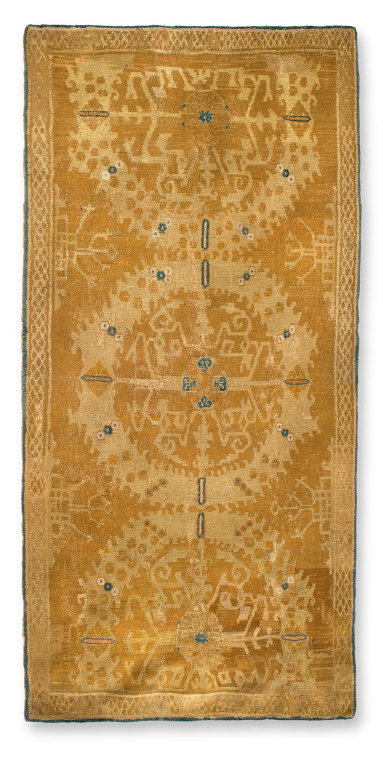
Cuenca wreath carpet
First half of the 17th century
Woollen pile on woollen warp and weft, Spanish knots (encircling a single warp)
222 x 108 cm
Inv. 0771
Catalogue N. A694
Provenance
Bibliography
The production of carpets in Spain dates at least from the 13th century, during the period of the Arab occupation, but continued after the Reconquista, albeit still woven by Arab craftsmen and in the predominantly Moorish mudejar style. The major centres of production were located at Alcaraz and Cuenca in central Spain, where the more typically Moorish patterns were gradually replaced by others of Christian derivation. One of the most widely used of these as from the middle of the 15th century was a “wreath” motif probably drawn from the patterns of the more precious local silk production. Known specimens from Alcaraz, mostly on a red ground, present garlands laid out on the field in parallel rows or located in the centre and sometimes combined with heraldic animals. The yellow ground of the Cerruti carpet is, instead, more typical of Cuenca manufacture, the patterns of which were sometimes combined with elements of Ottoman- Turkish derivation, like the arabesque of the “Lotto” carpet. In this glowing specimen, developed in different shades of yellow, three large garlands (one entire in the centre and two interrupted by the border) are aligned on the central axis and contain sprig motifs apparently executed in total freedom with no precise geometric layout.
The very narrow border is decorated with a simple lace-like diamond pattern that completes and defines the composition.
Alberto Boralevi