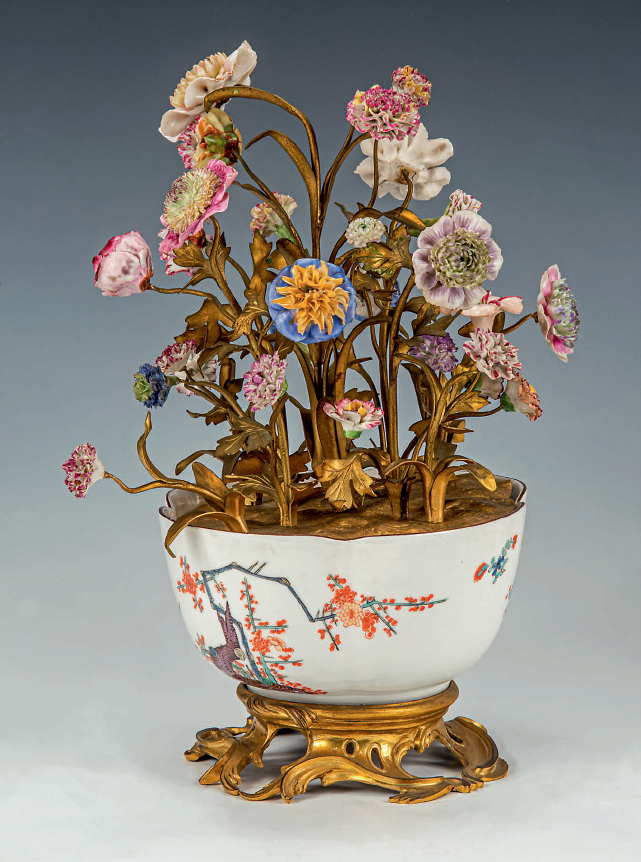
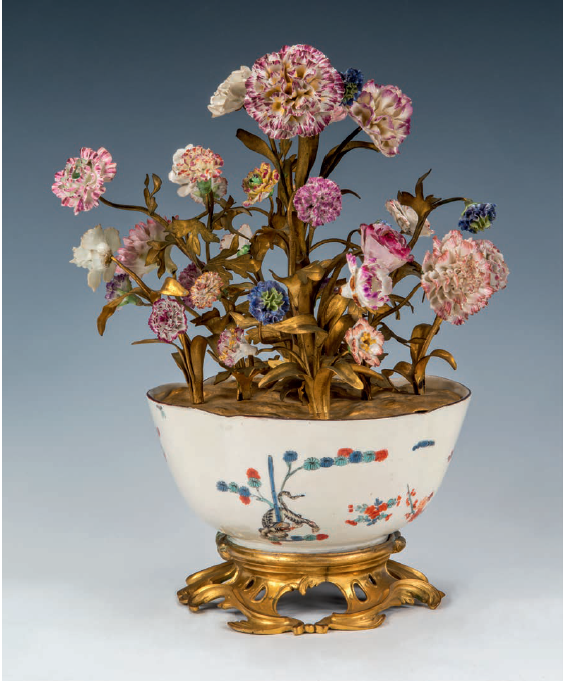
bowl-shaped vases decorated in kakiemon style with the“yellow tiger” (Gelber Löwe) motif
Meissen (coppa);
Francia (montatura e fiori in porcellana)
c. 1740 (bowl);
Second half of the 18th century (mount and porcelain flowers)
Painted porcelain, gilt bronze
35 x 20 x 20 cm
Inv. 0431
Catalogue N. A383a-b
Provenance
These quadrilobate bowls are painted in the kakiemon style featuring a yellow tiger with open jaws prowling around a blue bamboo plant, countered by a plum tree in bloom that rises up out of a trunk. The edges are profiled by a thin dark brown line. The kakiemon style derives from Japanese porcelain and is characterised by a reduced colour palette and by delicate plant and animal elements that stand out against the white background of the porcelain. In the Meissen factory, the “Gelber Löwe” or Yellow Tiger decoration was copied from the Japanese Arita porcelain in the collections of Augustus the Strong on the initiative of Count Hoym in collaboration with the Parisian merchant Rodolphe Lemaire in around 1730. They intended to pass the German copies off as Oriental originals on the foreign market, but the intrigue was uncovered and the porcelain pieces were requisitioned and taken to the Japanisches Palais in Dresden. Under Augustus III, the “yellow lion” motif became an exclusive attribute of the sovereign and an order was placed for a large service with this decoration. Numerous examples were taken to the Hof-konditorei in Dresden and from there to Warsaw, where they were used as a dessert service. The service was added to in several stages, so much so that it numbered a good 2,500 pieces in an inventory of 1764.1 These bowls were reused in the second half of the 18th century, or at a later date, as vases, fitted with a bronze mount and porcelain flowers from Vincennes or Chantilly. There is no trace of any inventory numbers on the base of the bowls, partially concealed by the mount.
Cristina Maritano
1 Regarding the history of the service, see Weber 2013, pp. 265-274.