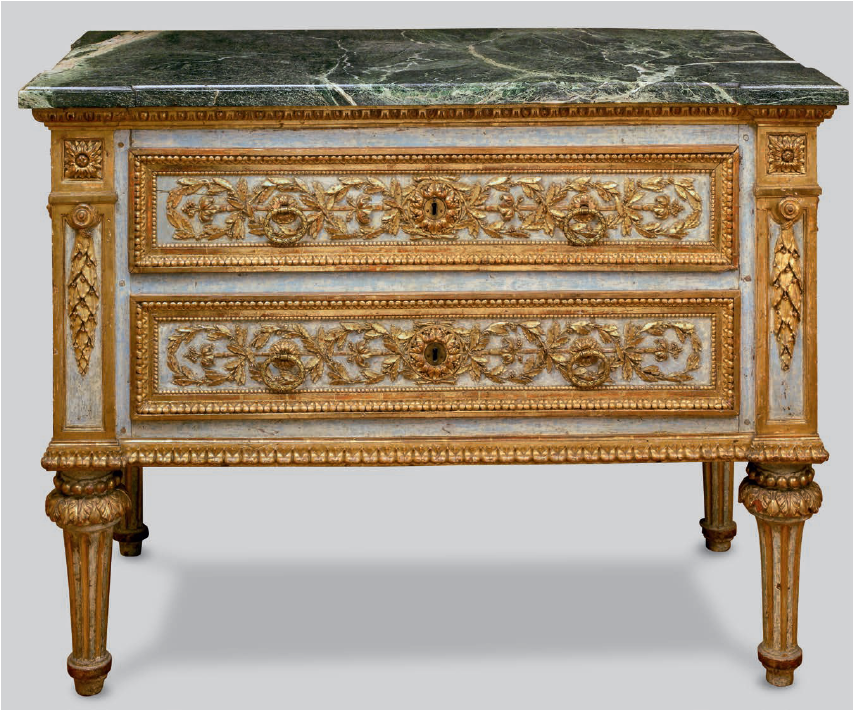
Chest of Drawers, Carved, Painted and Gilded
Francesco Bolgiè (attributed)
Torino
1789
92 x 124,5 x 61 cm (senza marmo)
Acquisition year 1996
Inv. 0328
Catalogue N. A285
Description
Provenance
This commode epitomises the excellence of decorative Turinese woodcarving in the last quarter of the 18th century. It stands out among the many surviving items in virtue of its elegant architectural balance and the sculptural power of the carving, which projects from the blue-painted ground with an exuberance not always to be found in the icy decorative repertoire of Turinese Neoclassicism.
It has two drawers, each of which is adorned with a laurel garland forming seven loops and a branch with blossom at either end running horizontally through them. The key plates are set in large rosettes and smaller rosettes are found on the handles together with laurel leaves. The drawers are set in a double frame with beading on the inside and a lesbian (or ivy motif) leaf moulding on the outside. Similar moulding motifs also run horizontally across the top and bottom of the front. The uprights are adorned with a rosette in a dado and the pilasters with a roundel and a laurel pendant.
The tall, tapering cylindrical legs, distinctly fluted and slightly splayed, are connected to the body of the commode by short necks adorned with beading and an upside-down vegetal calyx.
On each side, a frame with all the solidity and visibility of those used for paintings encloses a vegetal trophy consisting of a rosette in an oval surmounted by a bow and surrounded by realistically carved garlands of olive and laurel leaves.
By long-standing tradition, the name of Giuseppe Maria Bonzanigo is referred to in connection with every item of high-quality carved Neoclassical Piedmontese furniture. This is due to the popularity gained by the artist in his own lifetime, above all for his microsculptures, marvels of minute carving that made his workshop in Contrada di Po an obligatory stopping point for cultured visitors and a source of memories for their diaries.
The present author argued for a different attribution in 1985 by drawing attention to other woodcarvers of great decorative skill, first and foremost Francesco Bolgiè.1 The crucial turning point was due to Giancarlo Ferraris, whose publication of a huge amount of documentation2 in 1991 revealed the work of about thirty craftsmen of great stature previously overshadowed by Bonzanigo, confirming Bolgiè’s equal importance in the sphere of decorative woodcarving and highlighting the excellence of many others, including Giuseppe Antonio Gianotti (1739?- 1829?), Bartolomeo Manghetti (known 1775-92), Biagio Ferrero (known 1778- 1824), Domenico Taberna, Giuseppe Ghigo, Francesco Bozzelli, Matteo Brassé and Giovanni Venera. In particular, the chest of drawers discussed here, apparently one of a set of five, was attributed to Bolgiè by Ferraris on the basis of bookkeeping documentation dated 20 June 1789 from the Biblioteca Reale in Turin:3
“Memoria de’ lavori fatti per gli appartamenti delle L.L.A.A. Rli li Sigri Duca, e Duchessa d’Aosta alla Veneria Reale da me scultore Fran.co Bolgiè come segue:
.......
Più ornate e arrichite consimilmente da ogni parte due commode tutte ripiene di bassi riglievi arabeschi, arrichite con friggi, culi di lampade, rosoni, ghirlande di fiori, come anche intagliate tutt’all’intorno le gambe e generalmente tutte le cornici Lire 400
Più altre tre commode consimilmente ornate ma di diverso disegno
Lire 525”
Apart from the reference to “culi di lampade” or cul-de-lampe decorations (a corbel, resembling the conical bottom of ancient lamps), the brief description corresponds to the characteristics of the commode in question and its twin, sold in the Rossi auction and now in a private collection.
A drawing of a chest of drawers in the Biblioteca Civica, Turin,4 by the architect Giuseppe Battista Piacenza5 closely resembles the Cerruti commode (fig. 1). Written in ink different from that of the drawing are brief instructions for another two, then corrected to four, on the same model but different in size: “Veneria Reale. N. 4 [written over a 2]. Profondità inlusive [inclusive] la pietra on. 15. Una delle quali lunga once 26 e l’altra contornata simile a quella del Sig. Bolgiè. Torino li 22 del 1789. Piacenza Architetto di S.M.” The same ink was used on the design to draw dotted lines and specifications for a height of 23 once and a width of 28.6 These do not correspond to the proportions of the design and constitute indications for a commode with a narrower front, like the article now in the Cerruti Collection and its companion piece. While the design and the commode correspond in general terms, there are many differences and it is unclear how far these can be accounted for as due to the leeway for variation and addition granted to the craftsman with respect to the architect’s summary drawing, in which the carving that animates the cornices and the rosettes on the key plates and handles does not appear. The smaller number of foliate volutes is, instead, due to the lesser width of the commode. As a result of all this, the visual impact of the commode is undeniably different from the design. The truth is that even the most painstaking archival research can hardly arrive at the complete and incontrovertible identification of one hand among a large group of highly skilled professionals working in teams in the royal palaces to the instructions of the same royal architect.
In overall terms, however, the foregoing observations are sufficient for attribution of the commode in question to Bolgiè. The most persuasive piece of evidence is ultimately stylistic evaluation of the carving, which presents his characteristic solidity and handling of chiaroscuro, especially on the sides. What happened to the other commodes? One of the two that have been traced, the only one with the pendant frieze at the bottom shown in the drawing, is now in the Museo dell’Arredamento e dell’Ammobiliamento (Palazzina di Caccia, Stupinigi, near Turin). The other, which formed a pair with the Cerruti commode in 1978, is now in a private collection in Piedmont.7
Francesco Bolgiè (1752-1834, the year of birth being deduced by the statement on his death certificate that he died in 1834 at the age of eighty-two) was the son of the Milanese woodcarver Giovanni Battista, who became a subject of the House of Savoy and worked on the ornamentation of the royal carriages, being also documented as the author of two large torch holders in the church of Santa Teresa in Turin (chapel of San Giuseppe).8 It was evidently the monarchy that paid for Francesco to be sent to improve his skills in the art of carving in Paris, where the Savoy ambassador reported back to the court on his progress and conduct.9
As early as 1775, at the age of just twenty-three, he was appointed royal sculptor in wood with a yearly stipend of 300 lire. Bolgiè was the first to hold this position, being joined by Giuseppe Gianotti in 1779 and Bonzanigo in 1787 (both of whom received only 200 lire), and remained the first in importance. The records of payments to the fourteen artists to the court show that Francesco Bolgiè received the highest stipend of all.10
Active in the Castle of Moncalieri under the direction of Leonardo Marini in 1779 and during the 1780s, Bolgiè also worked in Venaria, Stupinigi, Rivoli, the Villa della Regina and for the Carignano family.11 As the payments show, he also played an important part in 1789 in the decoration of the apartments of the Dukes of Aosta in Palazzo Reale together with Bonzanigo and many others under the direction of the architect Giuseppe Battista Piacenza.
According to the 1792 census of arts and crafts, Bolgiè employed three workers, one of whom from Paris, as against the thirteen working for Bonzanigo, who was operating on a practically industrial scale. Bolgiè lived on Via Po in the district of San Ludovico and died in 1834.
The body of documents published by G. Ferraris has contributed to a revaluation of the work of this artist, who is certainly comparable to Bonzanigo in terms of quality albeit not of quantity, producing just under 600 articles of furniture as against almost 1,600, nearly 1,000 of which are, however, accounted for by sofas, armchairs, chairs, stools and pliants (as against 110 for Bolgiè). The numerical comparison is, instead, in Bolgiè’s favour as regards commodes (25 to 2), console tables (27 to 6), secretary desks (26 to 11) and picture frames (127 to 12) (and 110 for Gianotti).12 These figures regard only the work documented for the House of Savoy and do not include production for private clients, the records for which are minimal.
Roberto Antonetto
* The exhibition La casa italiana nei secoli (Florence, May- October 1948) was inaugurated on 30 May by the President of the Italian Republic Luigi Einaudi. See Florence 1948. As we read on p. 67, “all the splendid furnishing of the Turinese rooms (XXVI and XXVIII) was loaned with uncommon generosity by Pietro Accorsi of Turin.”
1 Antonetto 1985, pp. 354-355.
2 Ferraris 1991.
3 Biblioteca Reale di Torino, Recapiti, 20 June 1789.
4 Biblioteca Civica di Torino, Misc. Bosio 145.
5 Giuseppe Battista Piacenza (1735-1818), a pupil of Benedetto Alfieri, broadened his figurative horizons with long stays in Lombardy, Venice, Naples and perhaps Rome. A scholar and theoretician of architecture and drawing, he published his Notizie de’ professori del disegno da Cimabue in qua di Filippo Baldinucci integrate con dissertazioni, note, e aggiunte relative ai piemontesi in 1768 and 1770. Civil architect to the king from 1777, he was appointed primo architetto in 1796. Carlo Randoni was his assistant from 1787.
6 As the Piedmontese oncia (plural once) was equal to 4.2808 cm, this would mean a height of 98.5 cm and a width of barely 120 cm, which do not correspond to the measurements of the Cerruti commode.
7 Ferraris 1991, pp. 97-98, document 38, illustration LXXXIV, p. 111; Antonetto 2010, vol. I, pp. 382-383 (with previous bibliography).
8 Ferraris 1991, pp. 89-90.
9 Baudi di Vesme 1963-82, vol. I, pp. 150-151.
10 Archivio Storico di Torino, Sez. Riunite, Casa di S.M., Mandati, Registro 7012.
11 Colle 2005, p. 463 (entry by S. De Blasi with references to documents).
12 Ferraris 1991, “Quadri riassuntivi”, pp. 197ff.
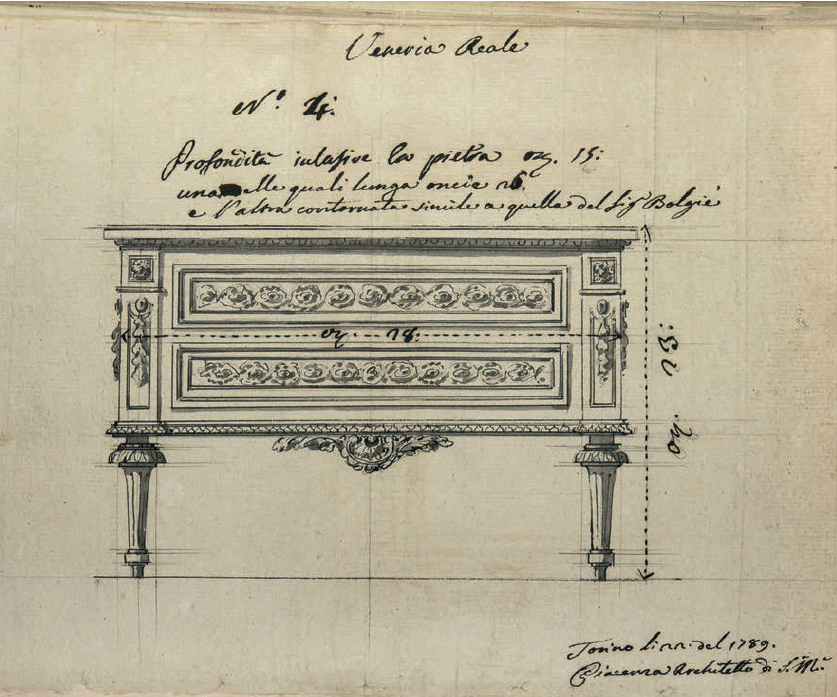
Fig. 1. Drawing by the royal architect Giuseppe Battista Piacenza. Turin, Biblioteca Civica.