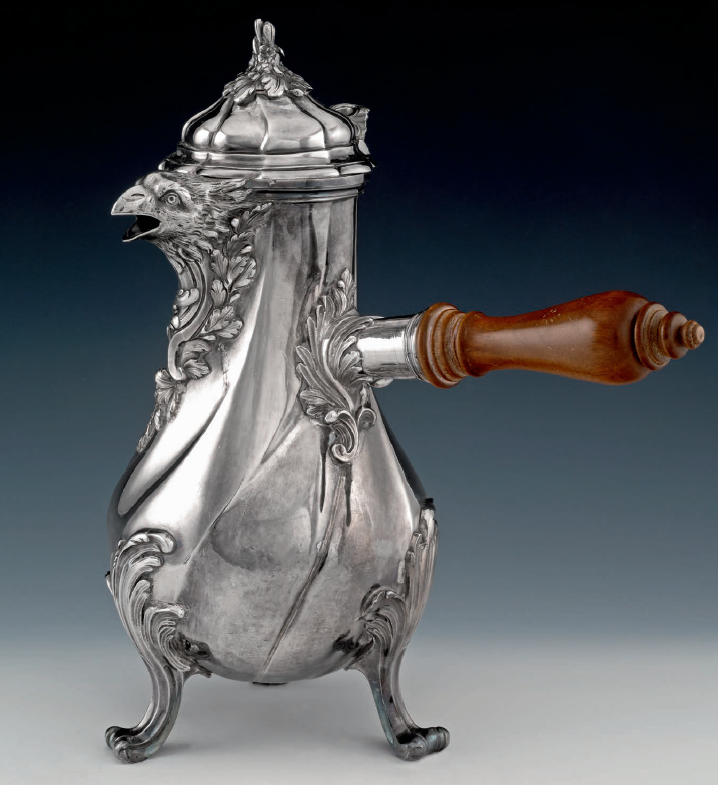
Coffee pot with spout in the shape of an eagle’s head
Giuseppe Balbino
1775-1780
Cast, repoussé and chased silver; turned wooden handle
34 x 32 x 18 cm;
peso 1790 g
Inv. 0460
Catalogue N. A408
Description
Provenance
Exhibitions
Bibliography
The pear-shaped body of this large coffee pot presents broad, twisted ribbing and rests on three volute-shaped feet. The cast and chased eagle’s beak is the distinguishing element of the object, regarded in the recent literature as one of the most significant works of the 18th-century Turinese silverware.1 The domed lid is crowned with an elaborate finial of flowers and leaves and a knob shaped to represent coffee beams. The handle of turned wood is attached horizontally with long vegetal volutes. Shown for the first time in 1959 at the Museo Poldi Pezzoli, Milan, in an exhibition of Italian silverware of the 16th-18th centuries together with another very similar item (now in the Museo della Fondazione Accorsi- Ometto, Turin),2 the pot was attributed in the catalogue to the silversmith Carlo Battista Bona on the basis of a misinterpretation of the mark as Our Lady of Mount Carmel. Four years later, in 1963, it was included among the silverware shown in the exhibition of the Piedmontese Baroque, where it appeared with no handle. The first and second assay marks of Francesco Pagliani, active 1775-87, were identified in the description by Augusto Bargoni. As regards the maker’s mark, closer examination of the punch made it possible to identify a half-length figure in profile holding a cross and the initials “G.B.”, which appear on various other items of Turinese silverware, initially interpreted as St Francis de Sales and associated with Giovanni Battista Bollea, master as from 1771. Bargoni published the same mark again in his book of 1976 on Piedmontese goldsmiths and silversmiths, identifying the male figure this time as St Charles Borromeo - the nose being very evident in the profile - accompanied by the letters “G.B.”, with a probable attribution to Giuseppe Balbino. Some doubts still remain today on the attribution of this mark to Balbino, as attested by the fact that Gianfranco Fina, who published the important coffee pot in his recent book on 18th-century Piedmontese silversmiths (where it appears with a different handle), observes in his description that the cross is not the identifying attribute of St Charles Borromeo and leaves the question open to some degree.3
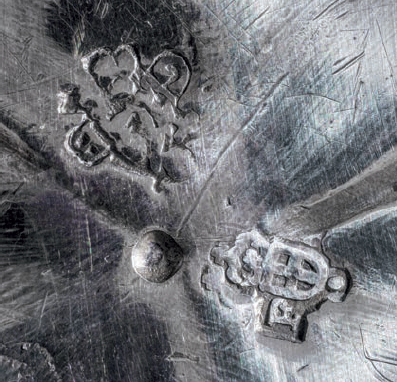
Fig. 1. Silversmith’s punch and assay mark.
The coffee pot reappeared on the antiques market in 1998 and entered the Cerruti Collection. If the identification of the mark is, in fact, correct, it is one of the finest works of the silversmith Giuseppe Balbino. The accompanying Visconteum authentication attests to its provenance from the House of Savoy.4 A member of the board of the guild of goldsmiths in 1777 and 1778, Balbino carried out a certain amount of work for the Savoy court as early as 1773, when he received payment for a pyx (a small round container used for carrying the consecrated host to those unable to come to church) for the internal chapel of Castello del Valentino.5 The surviving items of his work include the bedwarmer in the Palazzo Reale in Turin,6 several coffee pots, often characterised by eagle-head spouts, and sugar bowls.7
Clelia Arnaldi di Balme
1 Fina 2018, pp. 250-251, no. 99.
2 See Turin 2012, p. 65 no. 28.
3 Fina 2018, p. 250.
4 Cerruti Collection Archives.
5 Fina 1997, p. 57; L. Mana, “Elenco biografico degli argentieri presenti in questo volume”, in Turin 2012, p. 221.
6 A. Griseri, “Argentieri piemontesi a Palazzo Reale”, in Turin 1986a, p. 144, no. 34.
7 Turin 2012, pp. 193, 194, 201, nos. 260, 263, 287.
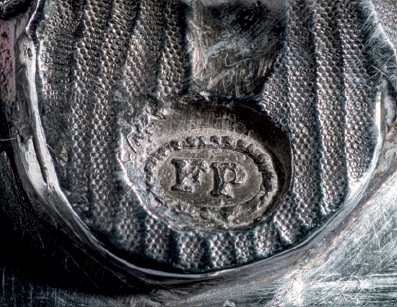
Fig. 2. Second assay mark.