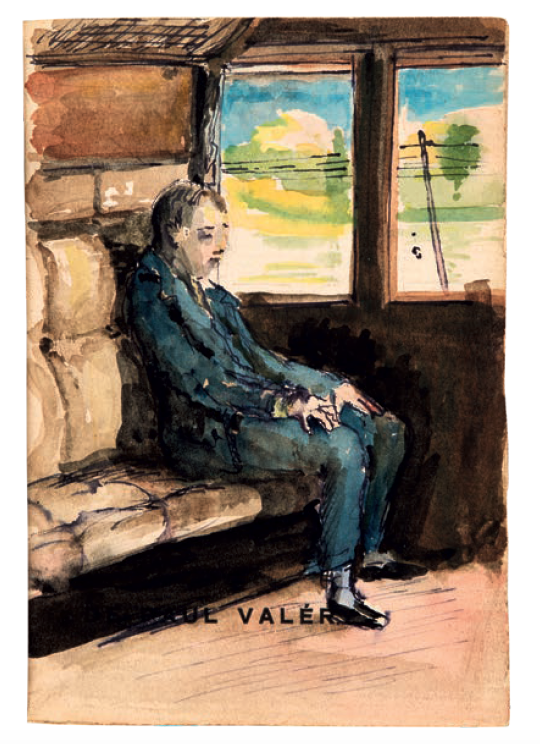
Au crayon et au hasard. Carnet écrit de 1910 à 1912
Paul Valéry
A. Delayance, La Charité-sur-Loire
Paris
1925
12mo (120 x 85 x 10 mm)
Inv. 0541
Catalogue N. A485
Description
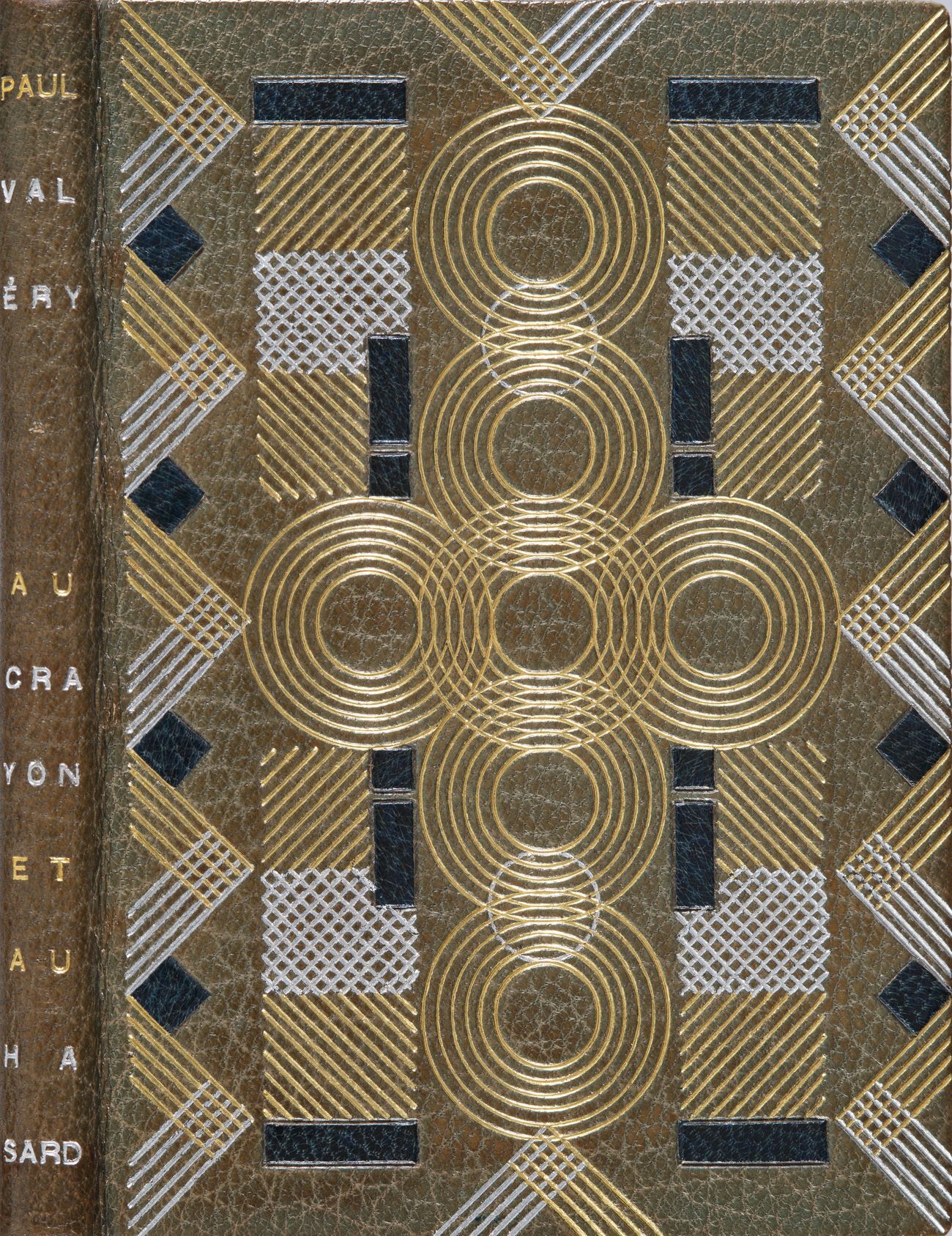
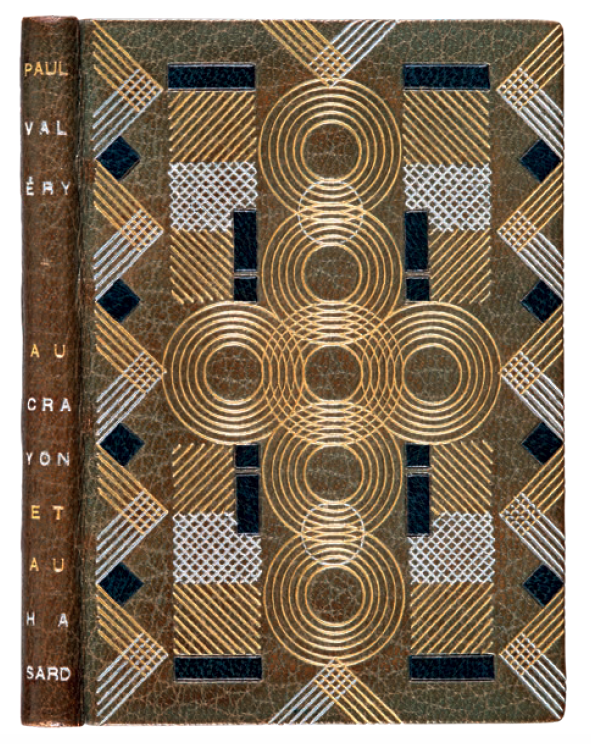
Paul Valéry, Au crayon et au hasard. Carnet écrit de 1910 à 1912, A. Delayance, La Charité-sur-Loire 1925
The binding was made in Paris and designed by Pierre Legrain. Many French 20th-century bindings have been so well made and so invisibly sewn that it is frequently impossible to determine the sewing structure. Moreover, as the paper used for the many of these books has no chain lines and the composition of the sections is invisible, it is difficult to establish the format.
Legrain was born in 1888 or 1889 in Levallois-Perret (on the outskirts of Paris); his father was a businessman who owned a distillery; his mother was of Belgian origin. He was apparently an obstinate child, finding his school studies at the Collège Sainte-Croix at Neuilly too slow and wanting to devote himself to design. Later he returned to the study of mythology, art history and ancient history. He was a widely cultured man. He studied art and design at the École Germain-Pilon. He worked in the atelier of the decorator Paul Iribe (who worked for Jacques Doucet) until just before the outbreak of the second World War in 1914; he also designed dresses and jewellery, fabrics and furniture.1 He was mobilised in 1914, but was invalided out of the army in 1916. He then had no work, but went to see Jacques Doucet (1853-1929: couturier and patron of the arts) who was looking for a modern designer for the bindings in his collection. Legrain designed fine bindings for Doucet and discovered his own love of beautiful books. He also worked for other bibliophiles. He wanted to escape all that had gone before in the way of binding design, aiming to transform binding design and creating a completely new style. Like Marius-Michel who broke away from pastiche with his floral designs, so did Legrain break away from all floral, botanical and emblematic decoration. He used geometric shapes, simple compared to the aesthetics of 1925, using onlays, fillets, dots and circles. At first his geometrical designs were not appreciated. Legrain knew nothing about the craft of bookbinding nor of the materials and techniques used. But he was interested in perfection. His designs were achieved with a ruler, a square and compasses; he used all kinds of metals, wood, mother of pearl, ivory, lacquer work, as well as leathers, fish skin and snakeskin, and had these tooled in gold, palladium or blind; he also used sheet metal (which did not tarnish unlike silver). His designs were not centred and he often put elements of the design at the outer edges of the covers. He often put the author’s name and/or title on the upper cover and he also used letters as decoration, inspired by typography. He wanted to link the text or the illustrations to the designs for the bindings. He said himself that a binding is not in itself significant, the cover is a frontispiece for the book, the design embodies the spirit of the text. To start with he made drawings and then asked various professional craftsmen to do his forwarding and finishing; René Kieffer made most of Legrain’s early bindings (1919-23). In 1924 he established himself in Rue d’Argenteuil, no. 7 and then in 1925 in the Avenue Percier. He worked with finishers, such as André Jeanne and Charles Collet, using René Desmules as forwarder. In 1926 he moved again, now to the Place du Val-de-Grace, where all processes were under his own control and where he produced his most famous bindings. In 1928 he wanted to leave Paris to buy a paper mill in Auvergne, but on 27 July 1929 he died of a heart attack. He was considered a creator of a style, an interpreter of literature and of graphic arts. According to Blaizot (who knew him well) his first bindings had a ticket on the flyleaf and they were simple bindings. Later he tooled his signature, as on the bindings described here. His career only spanned about 10 years. His work is characterised by taste, audacity, personality and intelligence; it has very high standards.
Jacques Anthoine-Legrain, whose work is also represented in the Cerruti Collection (Paul Tuffrau, Le roman de Renart), was the stepson of Pierre Legrain. He was born in 1907 and made his debut in 1929. He worked in Pierre Legrain’s studio and continued his stepfather’s tradition, using linear compositions, onlays and metal. In the 1930s he worked both as a designer and a technician.
Mirjam Foot
1 He also designed frames for paintings. Jacques Doucet owned paintings by Francis Picabia and Édouard Manet, in frames designed by Pierre Legrain. See “Artsology” (17 February 2017) for two frames by Legrain, one on Picabia, “Midi”, 1923-26 (now in Yale University Art Gallery). For Pierre Legrain, see Devauchelle 1959-61, vol. III, pp. 149-164; B. D. Maggs, in New York 1999, n. 94; Peyré, Fletcher 2004; Duncan, De Bartha 1989. It is possible that the silvery metal which Legrain used for tooling is aluminium rather than palladium.