Corner Wall Cupboard
Manner of Pietro Piffetti
110 x 41 x 54 cm
Inv. 0333
Catalogue N. A290
Description
Provenance
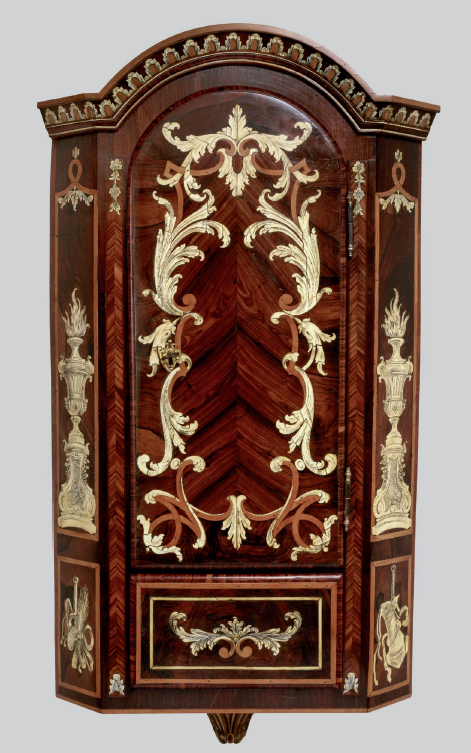
The structure is poplar wood with kingwood veneer and marquetry of boxwood and engraved ivory. The interior is completely relined with modern wood. The uncharacteristically awkward workmanship of the triangular drawer is to be found in no other work of the cabinetmaker to the king.
The door presents an eye-catching pattern of inlaid boxwood ribbons and overlapping acanthus leaves unquestionably designed by Piffetti, as is the decoration of the curved cornice. The ivory leaves and ribbons present numerous traces of the use of nails in a clumsy attempt to remedy detachment. A narrow strip of veneer with herringbone grain with a crudely engraved ivory element in no way attributable to Piffetti at the top and bottom is forcibly inserted vertically into the frame on either side of the door. A small shell-shaped, inlaid ornate bracket appears at the bottom.
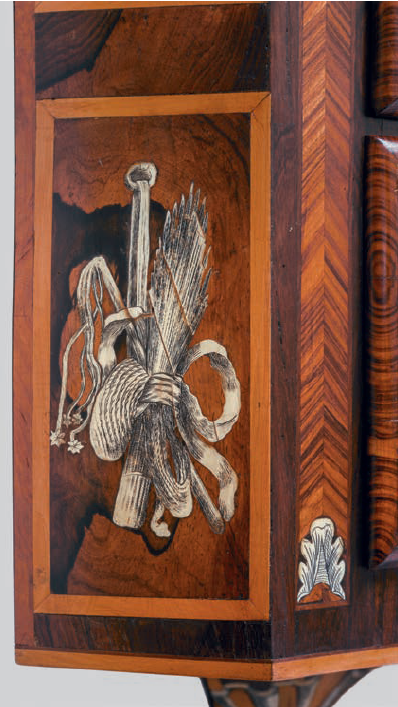
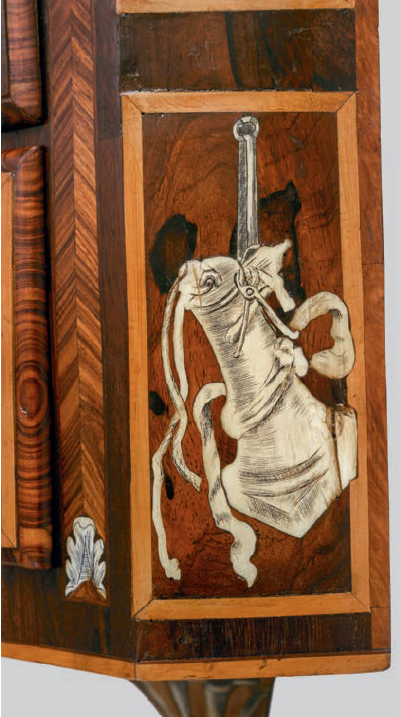
Each of the sides is decorated with a flaming urn resting on a bracket at the level of the door and with symbols of the Passion hanging from a ring by a ribbon below at the level of the drawer: the whips on the left and the column of the flagellation with the ropes and pincers on the right. While the flaming urn decorations are designed and executed by Piffetti, this cannot be said for the symbols of the Passion, which also differ in size and are inconsistent with respect to their background (the rings are set at different heights with a glaring lack of symmetry).
The symbols of the Passion (whips, column, ladder, spear, sponge, jug and basin, hand and tunic) are present in numerous items of Piedmontese furniture of the period and appear to derive from a single source or very similar drawings. Those of the Cerruti cupboard are to found, for example, by a far more skilful hand, on the pedestal of the large crucifix by Piffetti (Turin, Palazzo Madama, Museo Civico d’Arte Antica, inv. no. 1355/L),1 where the whips and column appear together on one of the crowns of the base above a cartouche with the inscription “Flagellatum tradidit eis” (Matthew, 27, 26).2 There is, however, evidently no comparison in terms of craftsmanship.
In conclusion, this item cannot be regarded as an example of the “minor” works that Piffetti’s workshop must also have turned out,3 but rather as an assemblage bearing witness to a somewhat undiscriminating “craze” for the master’s furniture.
Roberto Antonetto
1 Antonetto 2010, vol. I, pp. 236-238 (with previous bibliography).
2 They also appear, perhaps by the same hand, in a sacristy casket published in Antonetto 1985, p. 342, fig. 512. The casket also presents another commonly used allegorical image, namely the pelican feeding its young with its own blood, a symbol of the Church.
3 The wall cupboard was published in Ferraris 2004.