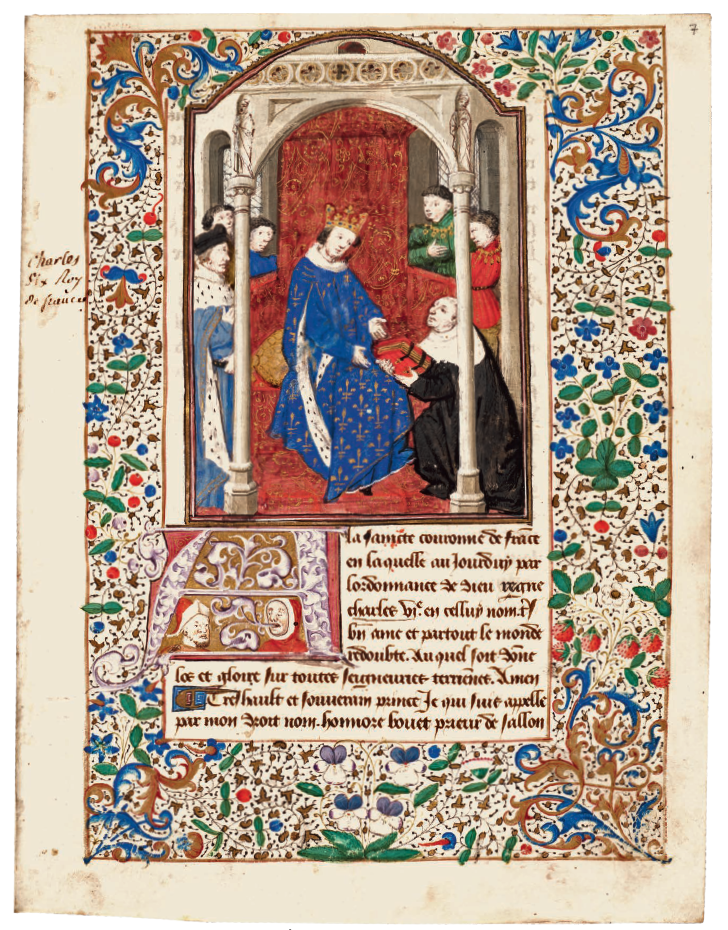
Arbre des batailles
Honorat Bovet
Paris
1455-1460
262 x 202 mm
Inv. 0717
Catalogue N. A641
Description
Provenance
Bibliography
The Arbre des batailles is an educational treatise in prose on the laws of warfare written between 1386 and 1389 by the Provençal prior and jurist Honorat Bovet (c. 1345/50 - before 1410), during a stay at the papal court in Avignon.1 The work, dedicated to Charles VI of Valois, to whom Bovet became an advisor, met with considerable success and rapid circulation. It survives in more than ninety copies, with six antique editions, and it was translated into Occitan, Catalan, Spanish and English.2 The first owner of the manuscript in question is unknown and we have no details about its history prior to its arrival at the Librairie Sourget in 2000 and its subsequent entry into the Cerruti Collection. In the sales catalogue, the full-page miniature on the frontispiece, showing Honoré Bovet in the act of offering the work to Charles VI surrounded by a number of court dignitaries, was generically but correctly attributed to an illuminator “fort inspiré par le Maître de Bedford”, the artist most in vogue in Paris during the English occupation. Indeed, it can be associated with the hand of a close assistant of that master, initially referred to as Bedford chief associate, and now known as the Maître de Dunois, after his patron Jean d’Orléans, Count of Dunois, for whom the artist produced one of his most beautiful Books of Hours (London, The British Library, Yates Thompson MS 3).3 The Maître de Dunois, who can perhaps be identified as Jean Haincelin,4 was active in Paris as an illuminator but also as a painter of painted panels between around 1436 and 1466, working for the most eminent figures in the court of Charles VII, prolonging the success of Bedford’s formulas and acting as a bridge between the last artists of International Gothic and those of the next generation, who were open to the innovative style that developed in the Netherlands around 1420-30. The narrative verve, inherited from his master, led the Maître de Dunois to produce a number of secular manuscripts. Only two Arbres des batailles produced by his workshop were known until now: Munich, Bayerische Staatsbibliothek, Cod. gall. 125 and Paris, Bibliothèque nationale de France, MS. fr. 1276, the latter dated 1460.6 The manuscript in the Cerruti Collection can be added to these and, like them, is a late product by the artist, as revealed by the less carefully finished contour drawing, a certain simplification in the palette and the more uncertain brushstrokes. The secondary decoration in the manuscript, especially the historiated initial on the frontispiece, can be attributed to a second artist who, according to an oral communication from François Avril, can be identified with the author of the ornamental decoration of a Book of Hours from the workshop of the Maître de Jean Rolin, a younger assistant and a follower of the Maître de Dunois (Vienna, Österreichische Nationalbibliothek, Cod. Ser. nova 13267).7
Giovanna Saroni
1 S. Gras, “L’arbre des batailles d’Honorat Bovet: d’un atelier d’Avignon aux ateliers parisiens”, in Elsig 2019, pp. 25-35.
2 The Arbre des batailles in the Cerruti Collection is not mentioned in the census drawn up in 2017 by Reinhilt Richter-Bergmeier, which also left out a copy of Bovet’s text at the Archivio di Stato in Turin and one in storage at the Bibliothèque municipale in Blois: Bovet 2017; and, for the Turin and Blois manuscripts, G. Saroni, cat. 294, in Turin 2011-12, p. 305, and P.-G. Girault, cat. 47, in Angers 2013-14, pp. 192-195.
3 The manuscript has been digitalised: http://www.bl.uk/manuscripts/FullDisplay.aspx?ref=Yates_Thompson_MS_3. Regarding the Maître de Dunois, so-called by Nicole Reynaud and previously baptised “Bedford chief associate” by Eleanor Spencer, see: Spencer 1963, pp. 277-299; Id. 1965, pp. 104-108; N. Reynaud, “L’Associé principal du Maître de Bedford ou Maître de Dunois”, in Paris 1993-94, pp. 36-38; Reynaud 1999, pp. 23-35; Ph. Lorentz, “La peinture à Paris au XVe siècle: un bilan (1904-2004)”, in Paris 2004b, pp. 89-92; F. Avril, cat. 221, in Paris 2004a, pp. 354-355.
4 On Jean Haincelin see Rouse, Rouse 2000, vol. II, pp. 73-74.
5 https://daten.digitale-sammlungen.de/~db/0006/bsb00065859/images.
6 https://gallica.bnf.fr/ark:/12148/btv1b9007044n.image.
7 http://digital.onb.ac.at/RepViewer/viewer.faces?doc=DTL_8066541&order=1&view=SINGLE.