Franciscan Antiphonary
Rimini
1314
550 x 385 mm
Inv. 0746
Catalogue N. A671
Description
Provenance
Bibliography

Franciscan Antiphonary, Rimini 1314
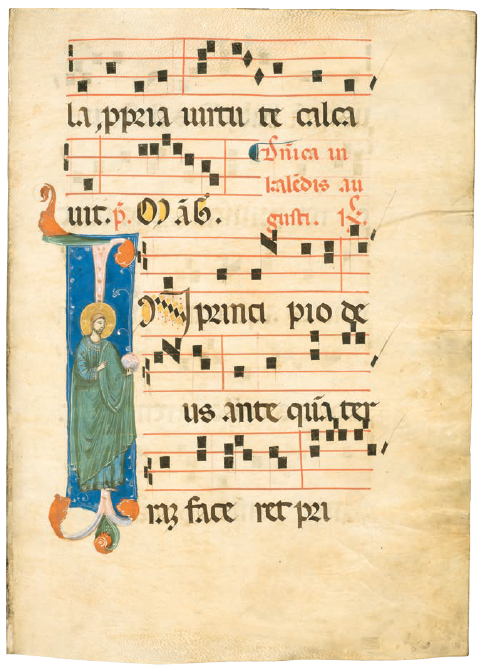
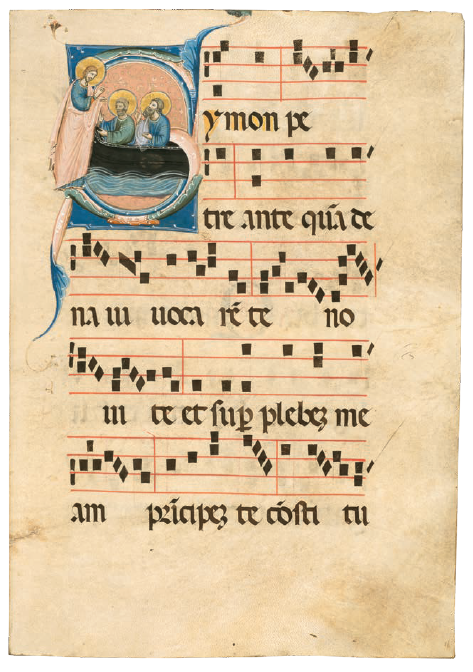
Known to the scholarship as the Amati Antiphonary after the London collector who, after the sale at Sotheby’s in 1982, recovered and reinstated the folios that had been removed and dispersed, the manuscript contains the Proprium de tempore (from the twelfth Sunday after Pentecost to the fourth Sunday in September) and the Proprium de sanctis (from the Feast of Sts Peter and Paul on 29 June to the Feast of the Seven Sorrows of the Blessed Virgin Mary on 15 September). The work presumably belongs to a series made for the convent of San Francesco in Rimini and must originally have comprised at least six antiphonaries, the surviving volumes and leaves of which are now dispersed throughout public and private collections.1
One of these sheets (Zurich, private collection), containing the antiphony of the vigil of the vesper for the Feast of Sts Peter and Paul and decorated with an initial containing the figure of St Peter, was identified as the first of the three missing from the Amati Antiphonary (fols. 77, 142, 158) at the time of its 1982 sale at Sotheby’s (fig. 1); likewise, a proposal was made to acknowledge the single leaf now preserved in Philadelphia (Free Library, Lewis E M 73:06), decorated with an initial inhabited by a Virgin enthroned, as another of those previously removed from the same manuscript (fol. 142 or 158, fig. 2).2
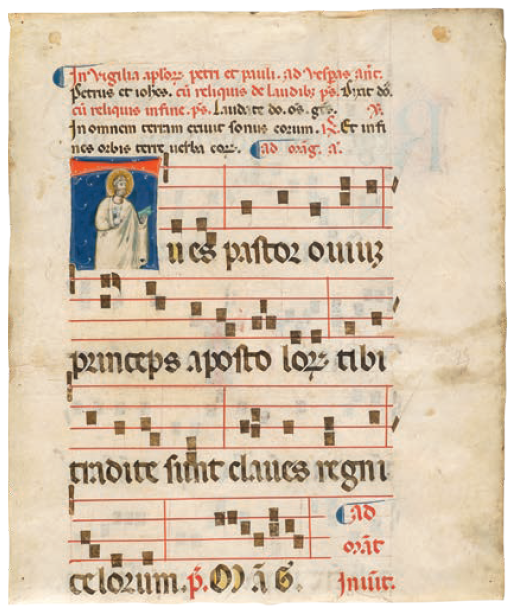
Fig. 1. Antiphonary leaf, figured initial “T” with St Peter. Zurich, private collection.
Along the lower margin of fol. 2 we can read the partially trimmed date “C m. ccc. xiiij” that, together with the name of the scribe “fr(ater) Bonfantinus antiquior de Bon(onia)”, is also to be found in another three manuscripts from the same series in Bologna (Museo Civico Medievale, MS. 540, fol. 1), in Krakow (Czartoryski Library, MS. 3464, fol. 1) and in Philadelphia (Free Library, Lewis, E M 68:7-9, fol. 1). In the Bolognese manuscript, the figure of a kneeling Franciscan in the decoration of the lower margin on fol. 3v shows an open book in which we can read the name “Riu(s)/ne”, a syllabic anagram of Nerius. This was Neri da Rimini, the illuminator whose work is well known between 1300 and 1338, thanks to archive documents and a considerable number of decorated manuscripts and single leaves.
The antiphonaries for San Francesco illustrate Neri da Rimini’s activity at its very peak: in comparison with the illuminator’s earliest works, the figures here appear to be sculpturally modelled and articulated, with a focus on rendering their facial features. This is probably the result of careful study of the art of Giotto, and particularly the work of his successors in Rimini, such as Giovanni and Pietro da Rimini. It has also been observed that the inhabited and historiated initials in the Amati Antiphonary, with figures and scenes of saints, reveal a stylistic evolution when compared with Neri’s earlier works: the colour palette is reduced, gold is reserved for the halos and, above all, the figures, who are dressed in clothes of a single colour, mostly a subtle secondary shade, and modelled with thin brown brushstrokes, stand out against colourful backgrounds (primarily blue), sometimes embellished by slender racemes or ornamental motifs in a paler colour.
Fabrizio Crivello
1 Dauner 1998, pp. 97-144.
2 G. Freuler, “398. Neri da Rimini. Rimini, ca. 1314. Antiphonarblatt mit der Bildinitiale T mit dem Apostel Petrus”, in Bücher & Autographen 2016, pp. 114-115.
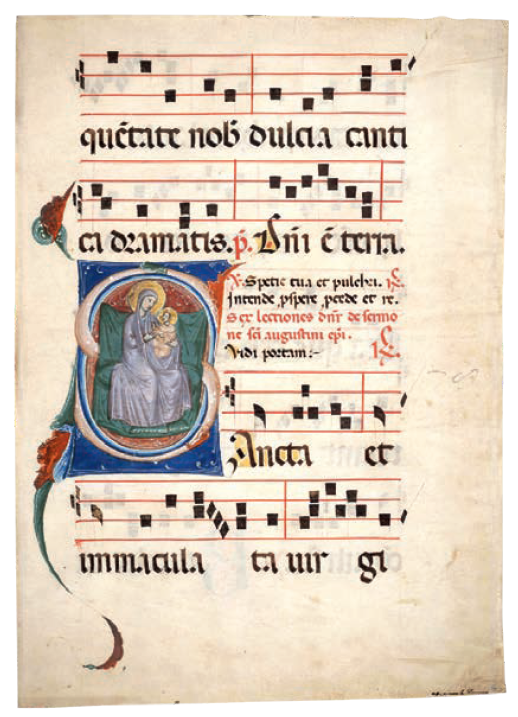
Fig. 2. Antiphonary leaf. Inhabited initial “S” with the Virgin enthroned and Child. Philadelphia, Free Library, Lewis E M 73:06.