
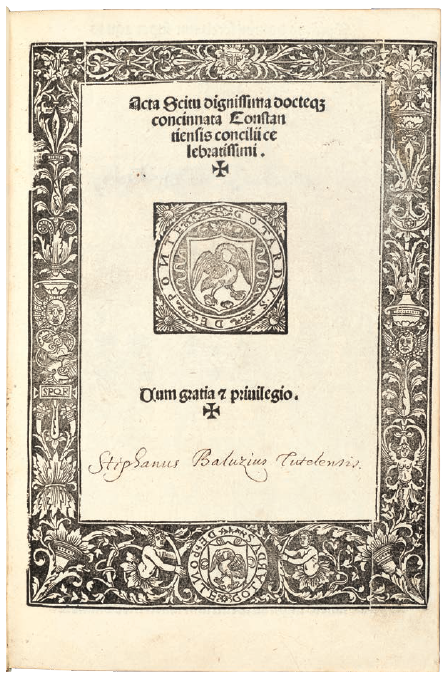
Acta scitu dignissima docteque concinnata Constantiensis concilii celebratissimi.
Ferrarius Zacharias
Gottardus Ponticus
Milan
1511-1512
in-folio (281 x 183 x 27 mm)
Inv. 0522
Catalogue N. A466
Description
This volume contains the description of the acts of the Council of Constance (1414-18) which brought about the end of the Western Schism and led to the condemnation of Jan Hus. These are followed by the acts of the Council of Basel and then the acts of the Council of Pisa. The book, which offers comprehensive documentation of the two great ecumenical councils, session by session, is a primary source of information on the history of the Church during the century prior to the Reformation and the development of conciliar theory. As well as being an extremely important historical document, the volume is also extremely beautiful. The large woodcut, repeated four times, shows the Council in session, chaired by the Pope. The incredible meeting packed with a huge number of people gives an idea of the size and spirit of this gathering and how it must have appeared to people at the time: over 300 cardinals, bishops and abbots, the court of Sigismondo and the courts of a number of princes with their entourages (15/20,000 foreign visitors in a city with fewer than 10,000 inhabitants), with a plethora of languages from across the known world which could be heard through the streets of Constance. The book closes with the forty-fifth and final session of the Council of Basel and the Papal Bull of Pope Nicholas V “super approbatione actorum & gestarum in Concilio Basiliensi, del 1449”, Ad Perpetuam Rei Memoriam. The final section - Apologia sacri Pisani concilii moderni - instead represents an attempt to refute the objections to the legitimacy of the council. The printer Gotard de Ponte was active in Milan in the first half of the 16th century. He also printed the famous Como Vitruvius of 1521.
Roberto Cena
The bindings of the Hypnerotomachia Poliphili (cat. p. 232) and the Acta in the Cerruti Collection were made in Paris for Jean Grolier. Grolier was born in the second half of 1489 or the first half of 1490, the son of Étienne Grolier, a wealthy Lyonese merchant. He was educated, partly in Paris, by the Italian humanist Gaspar Argilensis. He then entered the service of Louis XII as “notary and secretary of the King”. On his father’s death in 1509 he became Treasurer and Receiver General of the Duchy of Milan, which had been conquered by the French in 1499, a post which he occupied from 1509-12 and from 1515 until 1521. In 1520 he had married Anne Briçonnet. He was taken prisoner with François I at the battle of Pavia in 1525. On his return he settled in France, spending the rest of his life in Paris. In 1532 he became one of the Treasurers of France and from then until 1555 held lucrative posts in the financial service of his country. He died on 22 October 1565.1 He was an avid book collector. His early collection was acquired and bound in Italy, the majority in Milan. He owned three successive libraries: his Milanese library, lost at least in part in 1512 or 1521; the first French library, dispersed by a forced sale in 1536; and his final library, which at the time of his death may have contained about 300-400 different editions. During his life in France he used at least seventeen different Parisian binders. At one time or another during his life he owned five copies of the Hypnerotomachia (1499), bound by four different binders. The first binding described here was bound by the Fleurde- lis Binder, who was at work probably by 1536 and worked for Grolier between c. 1538 and 1540. Twenty bindings made for Grolier in this atelier are known. Grolier’s Last Binder, who was responsible for the second binding described here, worked for Grolier during the last ten years of his life during which time he bound twenty-three books for this remarkable French collector.
Mirjam Foot
1 See Nixon 1965; Austin 1971 (the numbers above refer to this catalogue); Hobson A. 1999.